Accredited Industrial Deadweight Tester Calibration in Sioux City, IA
Deadweight Tester Calibration in Sioux City, IA is performed by ISO/IEC 17025-accredited laboratories to recognized acceptance criteria, with documented uncertainty and NIST-traceable results.
Quote Deadweight Tester Calibration — Sioux City
Response within one business day
Service Overview
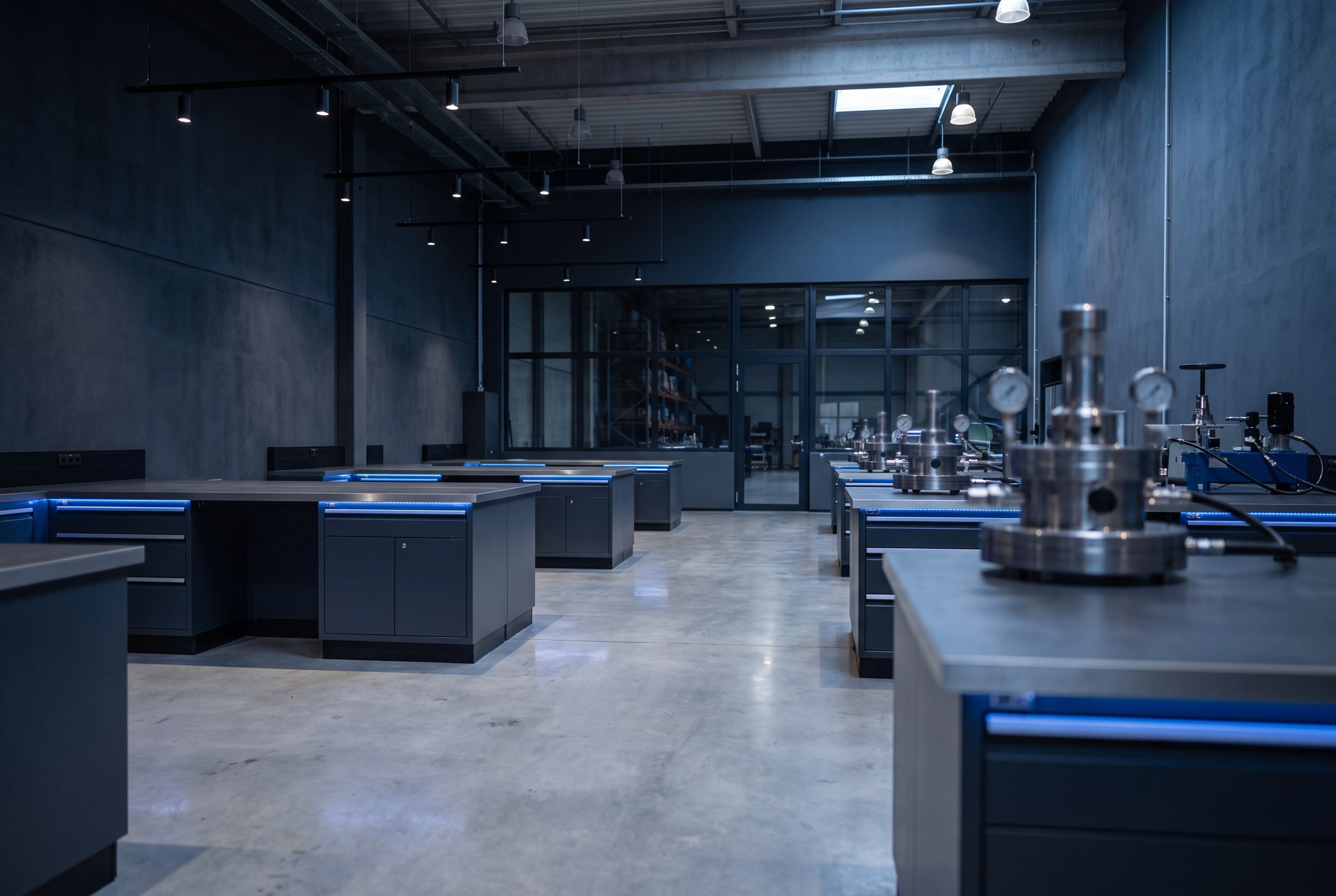
Pneumatic Deadweight Tester
Pneumatic deadweight testers serve as primary pressure standards, relying on the fundamental principles of mass, length, and time to generate highly accurate reference pressures. Calibration of these pneumatic systems is performed by comparing the device under test against a reference standard of higher accuracy or by cross-floating against a reference pressure balance. For pneumatic ranges, which typically encompass vacuum applications up to 1,000 psi (7 MPa), clean and dry nitrogen or air is utilized as the operating medium to prevent contamination of the precision piston-cylinder assembly. The calibration process establishes the effective area of the piston-cylinder and the true mass of the associated weight set.
To achieve metrological traceability to the International System of Units (SI), environmental and physical variables must be meticulously controlled. Calibration is performed under ISO/IEC 17025 accreditation protocols, ensuring that sources of measurement uncertainty are quantified and documented. Key parameters evaluated during the rigorous calibration of a pneumatic deadweight tester include:
- True mass of the bell, weight carrier, and individual weights, strictly adjusted for air buoyancy.
- Effective area of the piston-cylinder at a defined reference temperature and zero applied pressure.
- Thermal expansion coefficients of the specific piston and cylinder materials used in the assembly.
- Elastic distortion coefficient of the physical assembly under applied operational pressure.
- Local gravity corrections, necessary when the measurement system is matched to a specific operational latitude and elevation.
Hydraulic Deadweight Tester
Hydraulic deadweight testers serve as fundamental primary standards for pressure calibration, operating on the principle of generating a known pressure through a precisely machined piston-cylinder mechanism loaded with calibrated masses. Because these instruments are utilized to verify the accuracy of secondary standards, industrial pressure gauges, and sensitive transmitters, the calibration of the deadweight tester itself demands extreme precision. Calibration is performed under strict ISO/IEC 17025 accreditation protocols, typically employing a cross-float methodology against a higher-echelon reference standard to determine the precise effective area of the piston.
To ensure valid metrological traceability to the International System of Units (SI) through institutions such as NIST, the calibration process accounts for several critical physical and environmental variables that influence pressure generation. During the rigorous assessment of a hydraulic deadweight tester, the following parameters are evaluated and documented:
- Local gravity variance specific to the instrument's intended operational location.
- Air density measurements for accurate mass buoyancy corrections on the weight set.
- Thermal expansion coefficients of the specific piston and cylinder materials.
- Surface tension, fluid head corrections, and the specific density of the hydraulic medium utilized.
- Elastic deformation coefficients resulting from pressure exerted on the effective area.
Deadweight Tester
Primary pressure calibrations are executed utilizing pneumatic and hydraulic deadweight testers to achieve the lowest levels of measurement uncertainty. Calibration of these fundamental instruments is performed via cross-float methods or direct dimensional measurement of the piston-cylinder assembly, establishing direct traceability to the International System of Units (SI) through the National Institute of Standards and Technology (NIST). To maintain compliance with ISO/IEC 17025 accreditation requirements, the calibration process accounts for local gravity corrections, air buoyancy, piston-cylinder thermal expansion, and elastic deformation under high pressures.
- Pressure Range Coverage: Calibration capabilities span pneumatic systems from vacuum up to 15,000 psi and hydraulic systems up to 100,000 psi.
- Metrological Traceability: All reference standards and environmental monitoring equipment are maintained with unbroken chains of traceability to NIST.
- Uncertainty Budgets: Comprehensive uncertainty calculations incorporate factors such as mass value tolerances, piston area (Ae) determinations, and temperature coefficients.
- Standard Compliance: Calibration procedures align with international guidelines including EURAMET cg-3 and ASTM E1888/E1888M for pressure-defining instruments.
Deadweight Tester Calibration in Sioux City
More on deadweight tester calibration in Sioux City
Industrial Demand for Primary Pressure Standards in Sioux City
In the Sioux City metropolitan area, particularly within the Port Neal industrial complex south of the city, heavy chemical manufacturing operates alongside extensive agricultural processing. Facilities producing nitrogen-based fertilizers require continuous high-pressure synthesis loops, frequently operating at thousands of pounds per square inch. The internal metrology departments within these Woodbury County plants utilize deadweight testers as their foundational reference standards. These primary standards are essential for calibrating the secondary digital pressure calibrators, deadweight gauges, and HART communicators deployed directly on the plant floor. Given the high-hazard nature of anhydrous ammonia processing and pressurized chemical reactors, maintaining absolute certainty in pressure measurement across absolute, gauge, and differential pressure ranges is a baseline operational mandate. Further north, within the Bridgeport Industrial Park and Southbridge Business Park, large-scale meat processing and cold storage facilities operate massive industrial refrigeration networks. These closed-loop ammonia systems depend heavily on accurate pressure monitoring to prevent fugitive emissions, ensure thermodynamic efficiency, and comply with safety mandates. The calibration of a master deadweight tester provides the root traceable reference for every pressure transmitter and mechanical gauge across these sprawling campuses. Without precise periodic validation of the piston-cylinder assemblies and mass sets comprising the deadweight tester, the test uncertainty ratios across the entire facility's instrument hierarchy would degrade. This degradation inevitably leads to regulatory non-compliance, out-of-tolerance batch processing, and elevated facility safety risks under continuous operation environments.Metrological Traceability and Compliance Frameworks
The calibration of pressure balances and deadweight testers is governed by rigorous metrological protocols, notably EURAMET cg-3 and ISO/IEC 17025. Because a deadweight tester generates pressure fundamentally through the application of mass over a known area, calibration requires the exact determination of the piston's effective area and the true mass of the accompanying weight set. Furthermore, local gravity in Sioux City, Iowa - approximately 9.803 m/s2 - must be precisely factored into the mass-to-pressure conversion equations. The acceleration due to gravity varies significantly by latitude and elevation; failure to apply the specific local gravity constant compromises the reference standard's accuracy, rendering high-tier tolerance grades of 0.015% or 0.008% of reading completely invalid for critical compliance tasks. To satisfy complex regulatory frameworks, including OSHA Process Safety Management (PSM) for highly hazardous chemicals and USDA/FSIS directives for thermal processing in food production, unbroken traceability to the National Institute of Standards and Technology (NIST) is strictly required. The calibration process typically employs a high-resolution cross-float methodology against a higher-echelon reference standard, strictly controlling ambient temperature as per ASTM E220 to prevent piston-cylinder thermal distortion. Essential metrological variables quantified during this rigorous procedure include:- Measurement of the fundamental piston-cylinder clearance and calculation of thermal expansion coefficients for the specific alloy.
- Determination of the true mass and physical density of each weight to mathematically correct for ambient air buoyancy.
- Calculation of the effective area at atmospheric pressure and the inherent pressure distortion coefficient under maximum load.
- Evaluation of operating fluid surface tension, kinematic viscosity, and local environmental parameters during standard operation.
Related Services
Pressure Gauge Calibration
View in Sioux City ↗ RelatedDigital Pressure Gauge Calibration
View in Sioux City ↗ RelatedManometer Calibration
View in Sioux City ↗ RelatedPressure Transmitter, Transducer & Sensor Calibration
View in Sioux City ↗ RelatedPressure Switch & Relief Valve Calibration
View in Sioux City ↗ RelatedLeak Tester Calibration
View in Sioux City ↗Request deadweight tester calibration in Sioux City.
Submit instrument details to receive an itemized quote within one business day. NIST-traceable results, documented for audit and compliance.