Accredited Industrial Pressure Gauge Calibration in Sioux City, IA
Pressure Gauge Calibration in Sioux City, IA is performed by ISO/IEC 17025-accredited laboratories to recognized acceptance criteria, with documented uncertainty and NIST-traceable results.
Quote Pressure Gauge Calibration — Sioux City
Response within one business day
Service Overview
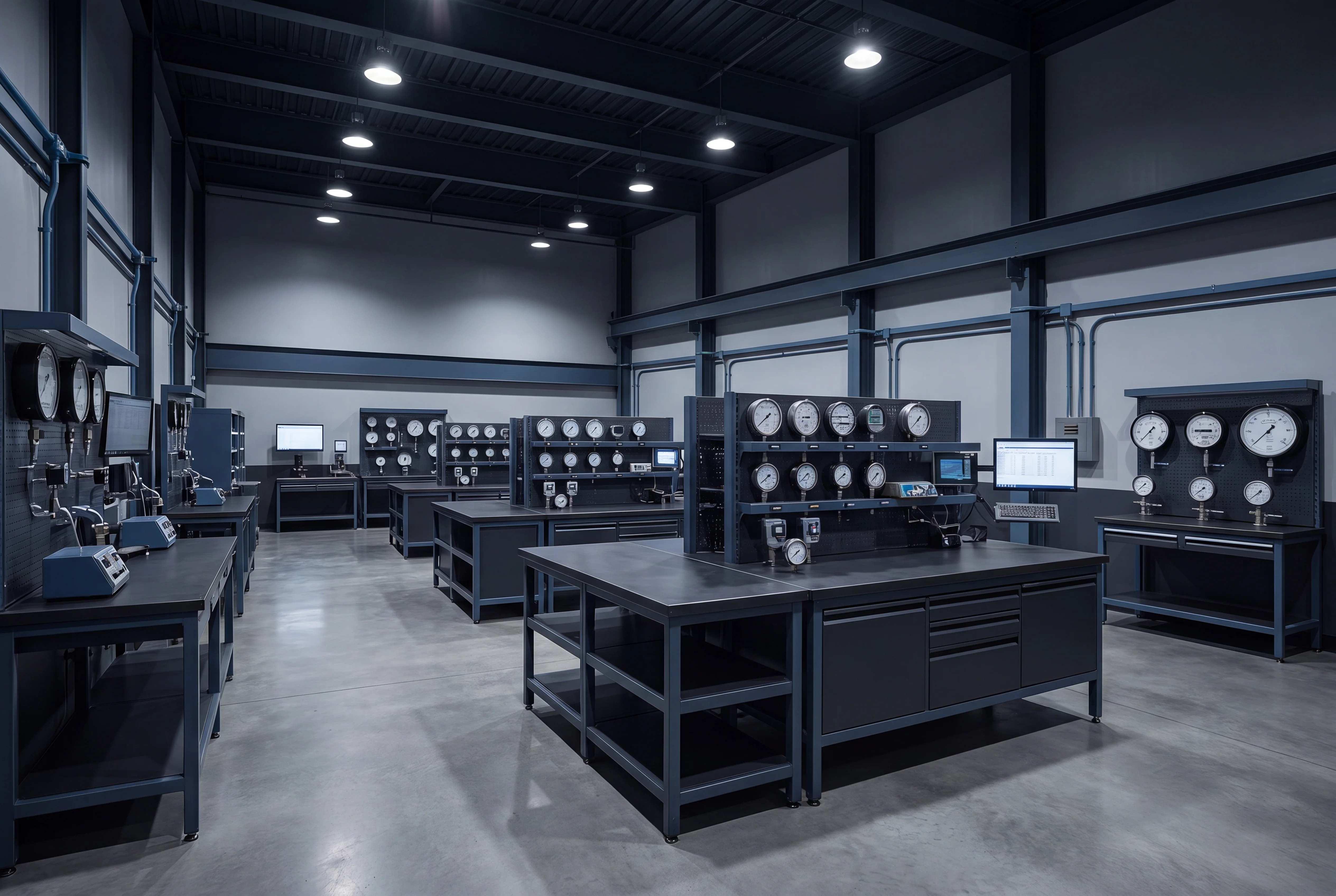
Bourdon Tube Pressure Gauge Calibration
Bourdon tube pressure gauge calibration requires precise control of environmental conditions and metrological traceability to address inherent physical characteristics such as hysteresis, linearity, and repeatability. Standard calibration processes are performed in accordance with ASME B40.100, which establishes accuracy grades, testing procedures, and permissible error limits for dial-indicating pressure gauges. Mechanical elements, including C-type, helical, or spiral Bourdon tubes, are subjected to controlled pressure increments and decrements to characterize elastic deformation behavior across the full scale of the instrument. To maintain compliance with ISO/IEC 17025 metrological requirements, the following parameters are systematically evaluated:
- Hysteresis and Repeatability: Measurement deviations are analyzed by comparing increasing and decreasing pressure cycles to identify material lag or mechanical wear.
- Linearity and Span: Calibration points are distributed across the gauge range to verify proportional pointer deflection and to adjust internal linkages if deviation exceeds specified tolerances.
- Friction and Tap Testing: The movement mechanism is evaluated before and after tapping the case to detect binding, gear wear, or excessive play in the segment and pinion.
- NIST-Traceable Reference Standards: Pressure generation is controlled using high-precision digital pressure controllers or deadweight testers, ensuring an appropriate test uncertainty ratio.
Diaphragm Pressure Gauge Calibration
Diaphragm pressure gauges are critical in low-pressure applications, sanitary processes, and highly corrosive environments where the process media must remain isolated from the measuring element. Calibration of these specialized instruments is performed to verify the structural integrity of the elastic diaphragm and the precision of the mechanical linkage transferring deflection to the pointer assembly. This metrological verification is executed in accordance with standards such as ASME B40.100 and Euramet cg-17, utilizing pneumatic or hydraulic pressure standards with direct NIST traceability.
Because diaphragm elements are susceptible to material fatigue, elastic hysteresis, and temperature-induced zero shifts, precise calibration procedures evaluate performance across multiple upscale and downscale points. The following parameters are systematically assessed during the process:
- Hysteresis and repeatability: Assessing variance in readings when pressure is increased versus decreased to identify potential material fatigue or mechanical binding.
- Linearity and conformity: Verifying that the non-linear displacement of the diaphragm translates uniformly across the graduated scale.
- Zero-point deviation: Quantifying shift anomalies caused by system overpressure or permanent set in the elastic element.
- Environmental thermal stability: Characterizing temperature-induced drift relative to calibrated reference baselines under controlled ambient conditions.
Pressure Gauge Calibration in Sioux City
The tri-state Siouxland region, centered around Woodbury County, Iowa, and extending into portions of Nebraska and South Dakota, serves as a hub for diverse manufacturing and industrial operations. High-capacity plants in this geographic area generate continuous demand for precise pressure gauge calibration to maintain operational integrity and safety. Various facilities in the area, such as the Seaboard Triumph Foods hog processing plant in Sioux City, the CF Industries Nitrogen complex in the Port Neal industrial zone, and Gelita USA in nearby Sergeant Bluff, rely on hundreds of pressure-critical instruments to manage their daily output. Additionally, heavy manufacturing operations like Sabre Industries, alongside regional food producers such as the Palmer Candy Company and Jolly Time Pop Corn, utilize pressure-dependent processes ranging from high-pressure hydraulic forming of transmission tower steel to clean-in-place (CIP) steam cycles. These operations require regular verification of analogue Bourdon tube gauges, digital pressure indicators, and differential pressure sensors to prevent costly downtime and maintain process stability across regional supply chains.
More on pressure gauge calibration in Sioux City
In these diverse industrial corridors, pressure variations can directly compromise product safety, equipment lifespan, and environmental compliance. For instance, chemical processing and ammonia synthesis at the Port Neal facilities require strict control of high-pressure lines to prevent hazardous overpressure conditions and ensure employee safety. Meanwhile, automated food processing lines must monitor pressure drops across filtration membranes, pasteurization loops, and aseptic packaging systems to comply with strict regulatory frameworks. These localized operational demands make routine calibration cycles indispensable for plants operating throughout the Sioux City metropolitan area. Regular calibration ensures that mechanical drift, vibration-induced wear, and thermal stresses do not compromise instrument accuracy over time. Consistent verification schedules support safe operational boundaries, prevent catastrophic vessel or line failures, and ensure high-throughput manufacturing environments function with predictable precision.
Technical Frameworks and Compliance Protocols
Pressure gauge calibration within regulated sectors is governed by strict national and international standards. Instrumentation utilized in local food, chemical, and feed processing plants must comply with regulatory frameworks such as FDA 21 CFR Part 211 for current good manufacturing practices (cGMP) and USDA sanitary guidelines. To meet these mandates, calibrations are executed in conformity with ISO/IEC 17025 accredited procedures, establishing an unbroken chain of traceability to the National Institute of Standards and Technology (NIST). Standard operating procedures require comparing the device under test against primary reference standards, such as hydraulic deadweight testers, pneumatic piston gauges, or high-precision digital pressure controllers. These reference standards typically maintain an accuracy ratio of at least 4:1 over the instrument being verified, ensuring that measurement uncertainty is minimized and documented in comprehensive calibration certificates.
The standard reference for mechanical and digital pressure-indicating instruments is ASME B40.100, which governs pressure gauges, elements, and cases. This standard defines specific accuracy grades, such as Grade 2A (with a permissible error of plus or minus 0.5 percent of span) or Grade 3A (plus or minus 0.25 percent of span), which are commonly required in critical processing systems. Calibration protocols involve a systematic multi-point verification process, typically testing the gauge at designated intervals across its full scale during both increasing and decreasing pressure cycles. This comprehensive testing reveals vital performance characteristics, including hysteresis, repeatability, and linearity deviations that might occur under harsh factory conditions. For hygienic applications, pressure gauges must also align with 3-A Sanitary Standards, employing aseptic process connections such as ASME BPE clamp fittings or DIN 11851 milk thread connections to prevent microbiological accumulation while sustaining accurate process measurement.
Related Services
Digital Pressure Gauge Calibration
View in Sioux City ↗ RelatedManometer Calibration
View in Sioux City ↗ RelatedPressure Transmitter, Transducer & Sensor Calibration
View in Sioux City ↗ RelatedPressure Switch & Relief Valve Calibration
View in Sioux City ↗ RelatedLeak Tester Calibration
View in Sioux City ↗ RelatedPiston Gauge Calibration
View in Sioux City ↗Request pressure gauge calibration in Sioux City.
Submit instrument details to receive an itemized quote within one business day. NIST-traceable results, documented for audit and compliance.