Accredited Industrial Digital Pressure Gauge Calibration in Fort Wayne, IN
Digital Pressure Gauge Calibration in Fort Wayne, IN is performed by ISO/IEC 17025-accredited laboratories to recognized acceptance criteria, with documented uncertainty and NIST-traceable results.
Quote Digital Pressure Gauge Calibration — Fort Wayne
Response within one business day
Service Overview
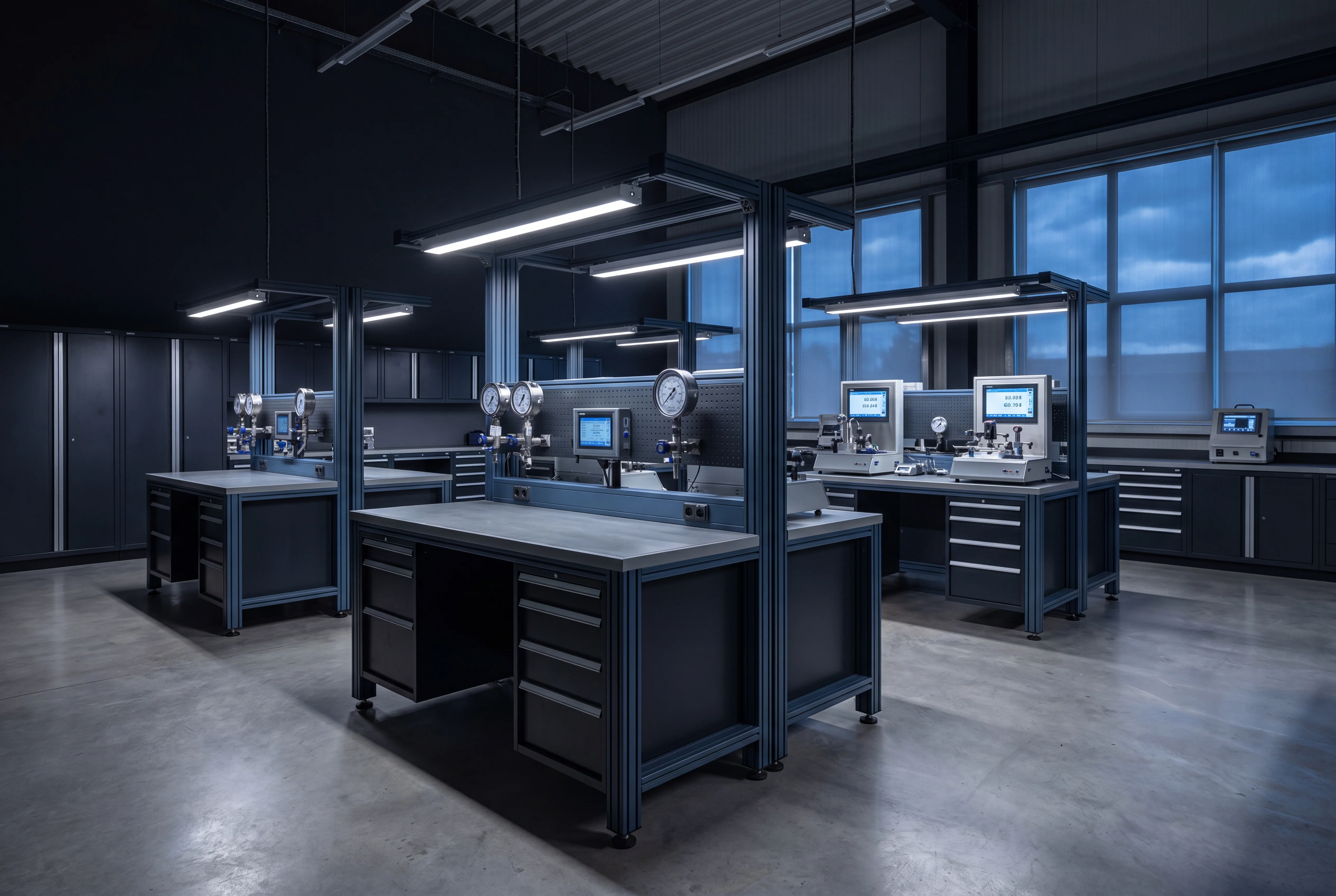
Gauge Reference Digital Pressure Gauge Calibration
Calibration of a reference digital pressure gauge is executed to establish reliable metrological traceability for secondary instrumentation. Because reference-class gauges typically offer accuracy limits of 0.05% to 0.01% of full scale (FS), the process demands high-stability pressure generation and superior reference standards, such as precision deadweight testers or higher-echelon automated controllers. Calibration is performed in accordance with recognized metrological guidelines, such as EURAMET cg-17 or ASME B40.7, ensuring that measurement integrity is rigorously validated. Pressure is applied across the entire operating range using a multi-point calibration cycle.
To accurately characterize the sensor, measurement data points are recorded in both ascending and descending pressure sequences. This systematic approach enables the precise calculation of critical performance parameters:
- Linearity: The deviation of the gauge's calibration curve from a specified ideal straight line.
- Hysteresis: The maximum difference in output at a specific pressure value when approached with increasing versus decreasing applied pressure.
- Repeatability: The ability of the digital indicator to reproduce consistent readings under identical test conditions.
- Measurement Uncertainty: A quantified parameter associated with the measurement result, critical for maintaining unbroken traceability chains to NIST or the SI.
Environmental conditions, including ambient temperature and local barometric pressure, are continuously monitored and documented, as they directly impact high-accuracy piezoresistive and resonant silicon sensors. Calibration is performed under strict ISO/IEC 17025 accreditation requirements, ensuring robust process controls and technical competence throughout the verification procedure.
Absolute Reference Digital Pressure Gauge Calibration
Calibration of an absolute reference digital pressure gauge requires establishing a reliable zero-pressure baseline that is entirely independent of local barometric fluctuations. Because absolute pressure is measured against a perfect vacuum, the calibration sequence is initiated by evacuating the test manifold to a deep vacuum before applying targeted positive test pressures. High-precision pressure controllers and absolute reference standards are utilized to verify the instrument's response across its designated span, while stringent environmental controls are maintained to mitigate temperature-induced zero drift or span errors within the internal piezoresistive or resonant silicon sensor arrays. To ensure compliance with stringent metrological requirements and to maintain uninterrupted measurement traceability to the SI through NIST, absolute pressure calibration protocols encompass several critical parameters:
- Zero Baseline Verification: Establishing the absolute zero reference point utilizing high-capacity vacuum pumps and characterized secondary vacuum standards.
- Multipoint Characterization: Execution of linearity, repeatability, and hysteresis testing in accordance with ASME B40.7 standard guidelines for digital pressure instrumentation.
- Media Compatibility: Utilization of clean, dry, non-corrosive gases, such as high-purity nitrogen, to prevent contamination or degradation of the sensing element.
- Accredited Documentation: Recording and evaluation of comprehensive as-found and as-left measurement data, performed under documented ISO/IEC 17025 accreditation.
Differential Digital Pressure Gauge Calibration
Calibration of a differential digital pressure gauge requires rigorous isolation and control of pressure media across two independent test ports. Unlike absolute or standard gauge pressure instruments, differential units measure the calculated delta between a high-pressure input and a low-pressure input. Verification is performed to assess both zero stability and span accuracy under varying static line pressures. Test routines typically involve applying equal pressure to both ports simultaneously to quantify common-mode error, followed by differential step configurations spanning the full scale of the instrument. All reference measurements are captured using high-precision digital pressure controllers or automated deadweight testers, ensuring continuous traceability to the International System of Units (SI) through the National Institute of Standards and Technology (NIST).
Routine service protocols for differential digital pressure instruments address multiple technical parameters to satisfy accredited industrial quality requirements:
- Verification of static line pressure specifications and zero-shift compensation.
- Multipoint linearity testing across both ascending and descending pressure cycles.
- Evaluation of media compatibility, utilizing controlled applications of clean dry air, nitrogen, or selected hydraulic fluids.
- Documentation of measurement uncertainty in strict alignment with ISO/IEC 17025 accreditation parameters.
- Calculation of hysteresis and repeatability errors in accordance with ASME B40.100 standard practices.
Digital Pressure Gauge Calibration in Fort Wayne
The manufacturing infrastructure throughout Allen County and the broader northeast Indiana region relies heavily on precise pressure measurement for process control and safety instrumentation. Within the industrial corridors surrounding Fort Wayne, including the facilities adjacent to the Interstate 69 artery, operations ranging from heavy automotive assembly to specialized defense electronics fabrication require the continuous monitoring of pneumatic and hydraulic systems. Digital pressure gauges are deployed extensively in these environments due to their superior resolution, automated data logging capabilities, and resistance to mechanical wear compared to traditional analog equivalents. In high-volume automotive production and Tier 1 supplier facilities, digital pressure instrumentation governs automated clamping systems, robotic painting applications, and high-pressure leak testing stations. Any uncorrected inaccuracy in these pressure readings can lead to compromised structural integrity, variations in applied coating thickness, or undetected seal failures in final automotive components.
More on digital pressure gauge calibration in Fort Wayne
Furthermore, the presence of aerospace engineering and defense contracting firms in the Fort Wayne metropolitan area introduces a strict requirement for highly accurate pressure monitoring in test stands and environmental simulation chambers. These specialized applications subject components to rapid pressure cycling and extreme fluid power loads, necessitating digital pressure instrumentation that maintains strict accuracy under dynamic, high-stress conditions. Northeast Indiana also serves as a critical geographic hub for orthopedic device manufacturing. Facilities producing medical implants and surgical instruments operate under rigorous regulatory scrutiny, requiring validated sterilization and precision cleaning processes that utilize digital pressure gauges to monitor autoclave chambers and cleanroom air filtration differentials.
The regional necessity for digital pressure gauge calibration is directly tied to the operational mandate of mitigating sensor drift. This electrical and mechanical drift is frequently induced by the harsh operational variables present in heavy manufacturing, including constant vibration from adjacent machinery, localized electrical interference, and exposure to fluctuating ambient temperatures across large factory floors. Consistent, documented calibration schedules are enforced to verify that these digital instruments continue to output highly reliable data for programmable logic controllers and central facility monitoring systems.
Compliance and Metrological Frameworks for Digital Gauges
The technical execution of digital pressure gauge calibration must satisfy the rigorous compliance frameworks governing Fort Wayne's heavy industrial, defense, and medical device sectors. Calibration procedures are heavily guided by established metrological standards, notably ASME B40.7, which specifies the detailed performance and testing parameters for digital electromechanical pressure-indicating instruments. Calibration protocols require a comprehensive evaluation of the gauge's fundamental metrological characteristics, ensuring accurate communication with automated facility networks.
- Linearity and Hysteresis: Bidirectional multi-point verifications are conducted across both the ascending and descending ranges of the instrument to identify mechanical hysteresis within the internal transducer and evaluate overall sensor linearity.
- Zero Stability: Procedures assess the analog-to-digital converter's baseline zero stability to prevent compounded software errors during critical low-pressure process measurements.
- Measurement Uncertainty: ISO/IEC 17025 accredited methodologies dictate the calculation and reporting of measurement uncertainty, incorporating reference standard variances, environmental fluctuations, and digital display resolution constraints.
Facilities supplying the automotive sector operate under demanding IATF 16949 quality management systems, while those integrated into the defense and aerospace supply chains must strictly adhere to AS9100. Medical device manufacturers in the region are bound by FDA 21 CFR Part 820 quality system regulations. These frameworks universally mandate unbroken, fully documented NIST traceability for all measurement equipment utilized in quality-critical production processes. To achieve this mandatory traceability, calibration routines employ reference standards, such as precision deadweight testers or automated pneumatic pressure controllers, that possess an accuracy ratio significantly higher than the digital device under test.
Acceptance criteria are definitively established by the tolerance grades set by the instrument manufacturer or specific internal process engineering requirements, which typically demand operating accuracies of 0.25%, 0.1%, or even 0.05% of full scale for high-precision digital test gauges. If a device fails to meet these tight tolerances during initial testing, "as found" performance data is formally recorded before appropriate internal span corrections or zero adjustments are applied to the device firmware. This is followed immediately by a secondary verification sweep to accurately capture and document the "as left" operational condition. Proper environmental conditioning prior to the calibration sequence is also paramount; thermal coefficients can significantly impact the piezoresistive or capacitive sensors located inside the digital gauge housing, making pre-calibration temperature stabilization essential for ensuring reliable measurement performance across diverse thermal environments.
Related Services
Pressure Gauge Calibration
View in Fort Wayne ↗ RelatedManometer Calibration
View in Fort Wayne ↗ RelatedPressure Transmitter, Transducer & Sensor Calibration
View in Fort Wayne ↗ RelatedPressure Switch & Relief Valve Calibration
View in Fort Wayne ↗ RelatedLeak Tester Calibration
View in Fort Wayne ↗ RelatedPiston Gauge Calibration
View in Fort Wayne ↗Request digital pressure gauge calibration in Fort Wayne.
Submit instrument details to receive an itemized quote within one business day. NIST-traceable results, documented for audit and compliance.