Accredited Industrial Pressure Gauge Calibration in Duluth, MN
Pressure Gauge Calibration in Duluth, MN is performed by ISO/IEC 17025-accredited laboratories to recognized acceptance criteria, with documented uncertainty and NIST-traceable results.
Quote Pressure Gauge Calibration — Duluth
Response within one business day
Service Overview
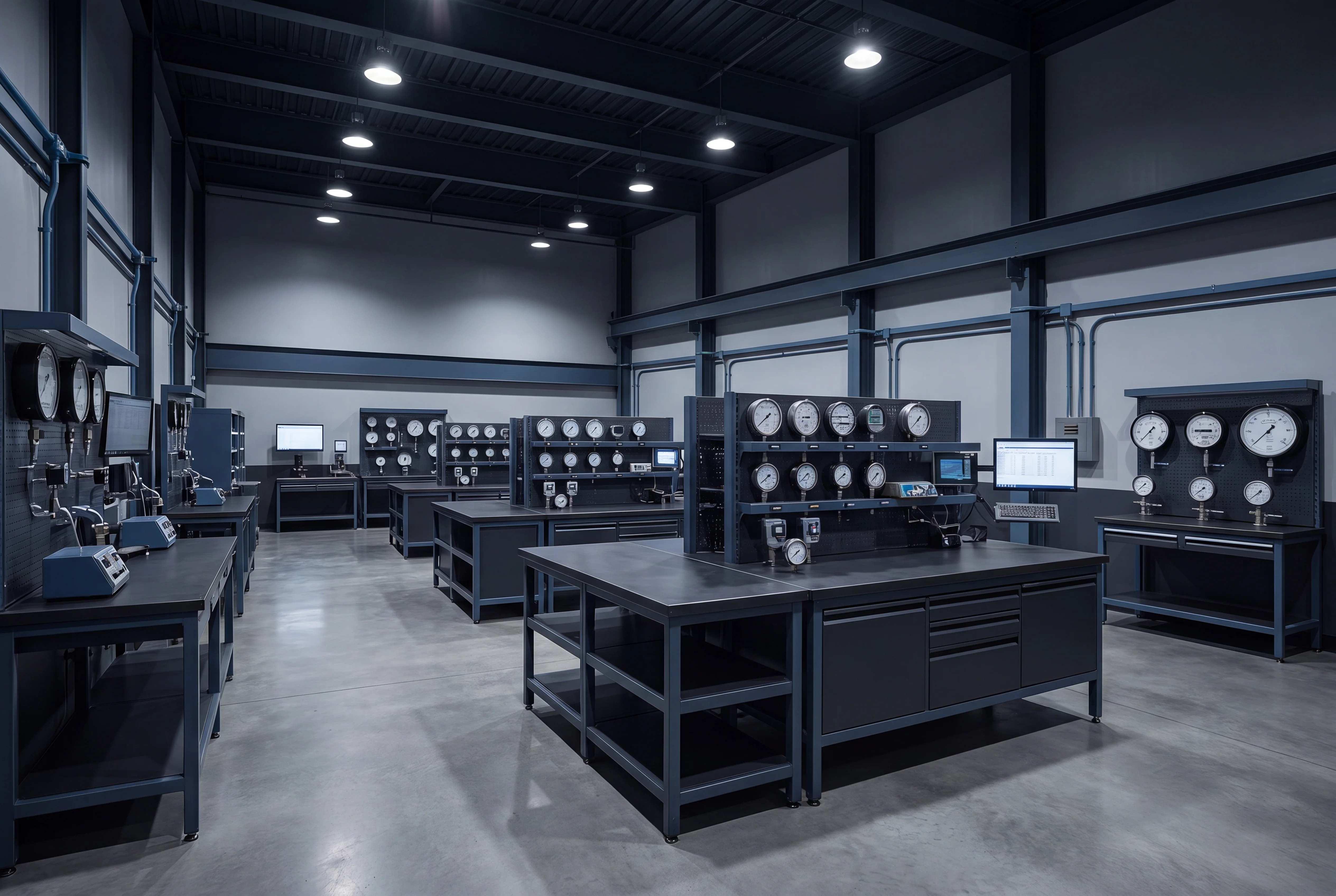
Bourdon Tube Pressure Gauge Calibration
Bourdon tube pressure gauge calibration requires precise control of environmental conditions and metrological traceability to address inherent physical characteristics such as hysteresis, linearity, and repeatability. Standard calibration processes are performed in accordance with ASME B40.100, which establishes accuracy grades, testing procedures, and permissible error limits for dial-indicating pressure gauges. Mechanical elements, including C-type, helical, or spiral Bourdon tubes, are subjected to controlled pressure increments and decrements to characterize elastic deformation behavior across the full scale of the instrument. To maintain compliance with ISO/IEC 17025 metrological requirements, the following parameters are systematically evaluated:
- Hysteresis and Repeatability: Measurement deviations are analyzed by comparing increasing and decreasing pressure cycles to identify material lag or mechanical wear.
- Linearity and Span: Calibration points are distributed across the gauge range to verify proportional pointer deflection and to adjust internal linkages if deviation exceeds specified tolerances.
- Friction and Tap Testing: The movement mechanism is evaluated before and after tapping the case to detect binding, gear wear, or excessive play in the segment and pinion.
- NIST-Traceable Reference Standards: Pressure generation is controlled using high-precision digital pressure controllers or deadweight testers, ensuring an appropriate test uncertainty ratio.
Diaphragm Pressure Gauge Calibration
Diaphragm pressure gauges are critical in low-pressure applications, sanitary processes, and highly corrosive environments where the process media must remain isolated from the measuring element. Calibration of these specialized instruments is performed to verify the structural integrity of the elastic diaphragm and the precision of the mechanical linkage transferring deflection to the pointer assembly. This metrological verification is executed in accordance with standards such as ASME B40.100 and Euramet cg-17, utilizing pneumatic or hydraulic pressure standards with direct NIST traceability.
Because diaphragm elements are susceptible to material fatigue, elastic hysteresis, and temperature-induced zero shifts, precise calibration procedures evaluate performance across multiple upscale and downscale points. The following parameters are systematically assessed during the process:
- Hysteresis and repeatability: Assessing variance in readings when pressure is increased versus decreased to identify potential material fatigue or mechanical binding.
- Linearity and conformity: Verifying that the non-linear displacement of the diaphragm translates uniformly across the graduated scale.
- Zero-point deviation: Quantifying shift anomalies caused by system overpressure or permanent set in the elastic element.
- Environmental thermal stability: Characterizing temperature-induced drift relative to calibrated reference baselines under controlled ambient conditions.
Pressure Gauge Calibration in Duluth
The industrial landscape of Duluth, Minnesota, and the surrounding Twin Ports region generates substantial demand for precise pressure gauge calibration across a spectrum of heavy manufacturing, maritime shipping, and resource extraction sectors. Situated at the western terminus of the Great Lakes and St. Lawrence Seaway, the Port of Duluth-Superior handles millions of tons of bulk cargo annually. Within this maritime infrastructure, commercial vessels, bulk loading terminals, and hydraulic lifting systems rely heavily on accurate pressure instrumentation. Boiler pressure vessels, pneumatic control lines, and hydraulic power units on bulk freighters require routine calibration of mechanical and digital pressure gauges to ensure operational safety and compliance with maritime engineering standards. The harsh operational environment of Lake Superior, combined with extreme winter temperature differentials, frequently causes mechanical stress and sensor drift in outdoor instrumentation, necessitating strict calibration intervals to maintain measurement reliability.
More on pressure gauge calibration in Duluth
Beyond the immediate port facilities, the broader St. Louis County region serves as a critical hub for aviation manufacturing and mining operations, each presenting distinct pressure measurement requirements. Aerospace facilities at the Duluth International Airport, such as those operated by Cirrus Aircraft, utilize calibrated pressure gauges for autoclave processing, composite material curing, and pneumatic leak testing. These aerospace applications demand high-accuracy instrumentation to maintain strict process control during fabrication. Concurrently, the regional economy is deeply tied to taconite mining and processing operations scattered across the Iron Range. Heavy excavation equipment, rock crushers, and slurry transport pipelines utilize robust hydraulic networks operating under extreme high-pressure conditions. The gauges monitoring these systems are subjected to severe pulsation, vibration, and abrasive environmental exposure. Regular pressure gauge calibration mitigates the risk of catastrophic system failure by detecting hysteresis and mechanical fatigue in bourdon tubes or electronic pressure transducers before they compromise process safety or mechanical efficiency.
Metrological Standards and Compliance Frameworks
Pressure gauge calibration procedures must adhere to rigorous technical standards to satisfy the compliance mandates governing Duluth's diverse industrial base. Calibration protocols are heavily influenced by ASME B40.100, which establishes the criteria for gauge dial sizes, pressure ranges, and permissible tolerance grades. Industrial gauges used in general manufacturing may be assessed against Grade B (3/2/3 percent of span) or Grade A (2/1/2 percent of span) tolerances, whereas critical test gauges utilized in aerospace or pipeline monitoring often require verification to Grade 2A (0.5 percent) or Grade 3A (0.25 percent) specifications. To ensure metrological integrity, gauges are tested against precision reference standards, such as high-accuracy digital pressure controllers or hydraulic deadweight testers. These reference standards must maintain documented, unbroken traceability to the National Institute of Standards and Technology (NIST) or an equivalent national metrology institute, satisfying a minimum test uncertainty ratio (TUR) of 4:1 whenever technically feasible.
Facilities operating under quality management systems such as ISO 9001, or aerospace-specific standards like AS9100, require comprehensive calibration certificates that detail specific performance characteristics. This documentation must provide both as-found and as-left measurement data taken across multiple points of the pressure span, explicitly recording values for hysteresis, repeatability, and linearity. For testing facilities requiring the highest level of regulatory compliance, adherence to ISO/IEC 17025 is mandatory. Under this standard, every calibration point must be accompanied by a calculated evaluation of measurement uncertainty, factoring in variables such as reference standard accuracy, environmental temperature fluctuations, and instrument resolution. In the context of maritime and pipeline operations, compliance with federal regulations further dictates calibration practices. Instrumentation monitored under United States Coast Guard regulations (Title 46 CFR) or Department of Transportation pipeline safety standards (49 CFR Part 195) demands verified pressure measurements to prevent overpressure events, ensure the structural integrity of transport vessels, and mitigate environmental hazards throughout the Great Lakes region.
Related Services
Digital Pressure Gauge Calibration
View in Duluth ↗ RelatedManometer Calibration
View in Duluth ↗ RelatedPressure Transmitter, Transducer & Sensor Calibration
View in Duluth ↗ RelatedPressure Switch & Relief Valve Calibration
View in Duluth ↗ RelatedLeak Tester Calibration
View in Duluth ↗ RelatedPiston Gauge Calibration
View in Duluth ↗Request pressure gauge calibration in Duluth.
Submit instrument details to receive an itemized quote within one business day. NIST-traceable results, documented for audit and compliance.