Accredited Industrial Manometer Calibration in Duluth, MN
Manometer Calibration in Duluth, MN is performed by ISO/IEC 17025-accredited laboratories to recognized acceptance criteria, with documented uncertainty and NIST-traceable results.
Quote Manometer Calibration — Duluth
Response within one business day
Service Overview
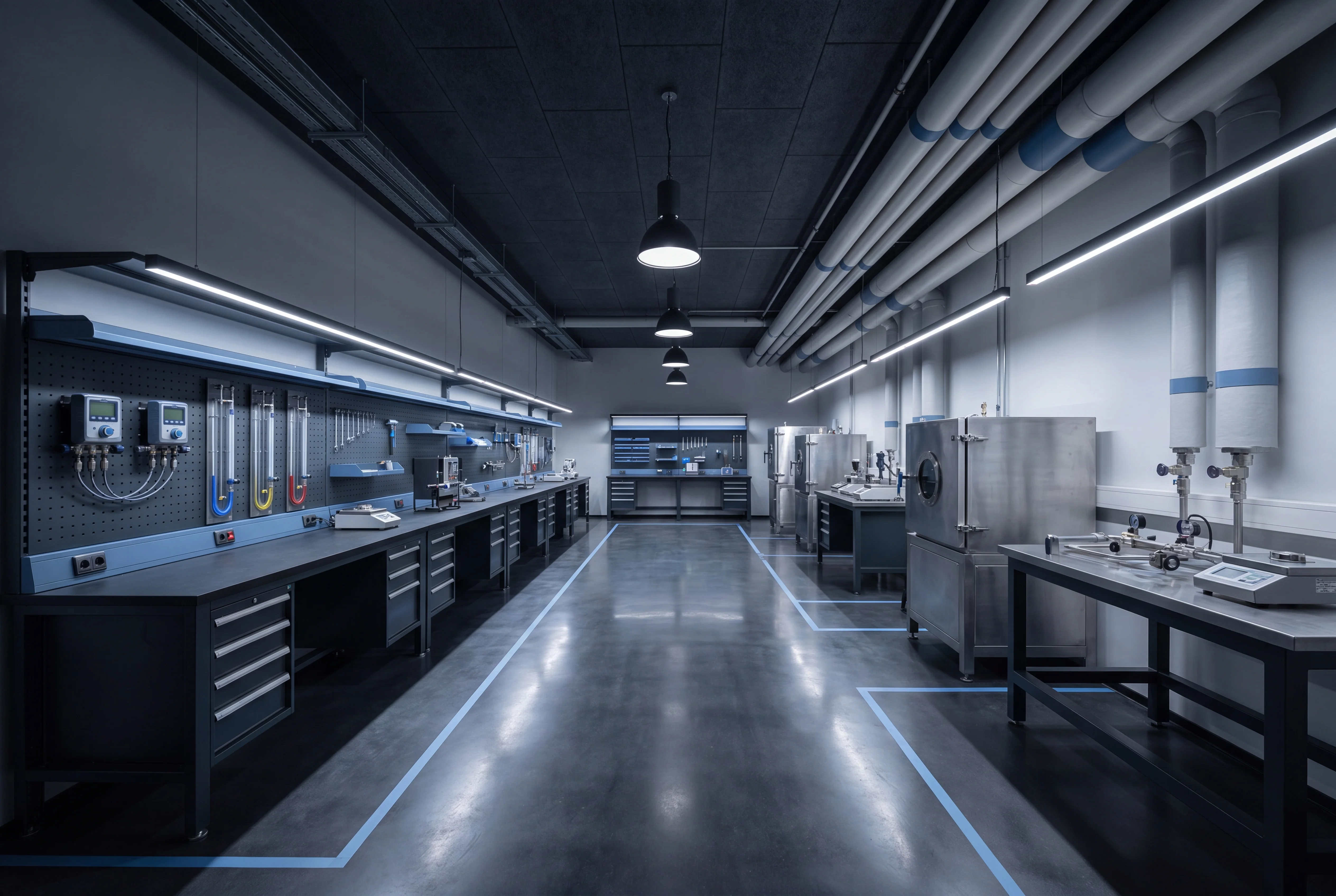
U-tube Manometer Calibration
Calibration of U-tube manometers requires rigorous evaluation of both the primary measurement scale and the fluid dynamics that dictate the indicated pressure. Because these instruments rely on the physical displacement of a liquid column - typically utilizing water, mercury, or proprietary gauge fluids - the calibration process must meticulously account for environmental variables that directly alter fluid density and hydrostatic equilibrium. Calibration is performed under ISO/IEC 17025 accreditation protocols to ensure documented measurement traceability to national metrology standards, such as those maintained by NIST. The verification procedure involves applying highly stable reference pressures using precision automated controllers or deadweight testers, subsequently comparing the standard against the manometer's observed differential height.
Critical parameters evaluated during this calibration sequence include:
- Verification of scale linearity, absolute zero-point alignment, and graduation accuracy across the entire operational range.
- Application of critical temperature corrections, as thermal expansion continuously alters the specific gravity of the indicating fluid.
- Mathematical compensation for local gravity variations, which fundamentally impact the primary hydrostatic pressure calculation.
- Inspection of the bore tubing for internal contamination or surface tension anomalies that could distort the meniscus and induce parallax reading errors.
- Pneumatic leak testing of the manifold and connection fittings to confirm absolute system integrity under sustained static pressure.
Digital Manometer Calibration
Digital manometer calibration is performed under strict ISO/IEC 17025 accredited procedures to ensure the integrity of electronic pressure measurements. Unlike liquid-column counterparts, digital manometers rely on piezoresistive or silicon capacitive sensors, which require precise voltage-to-pressure correlation. High-accuracy pneumatic or hydraulic comparators are utilized alongside NIST-traceable reference standards to evaluate the device across its full operating range. The calibration process involves multi-point verification to analyze key performance characteristics:
- Hysteresis and Linearity: Assessment of sensor response during both increasing and decreasing pressure cycles to identify deviations in the transducer element.
- Repeatability: Evaluation of the instrument's ability to provide consistent readings under identical pressure conditions.
- Zero and Span Adjustment: Corrections applied to align the digital output with reference standards at both zero pressure and full-scale limits.
- Temperature Effects: Verification of thermal compensation stability, as digital sensors are susceptible to drift caused by ambient temperature fluctuations.
All measurements are conducted in accordance with ASME B40.7 standards, providing documented test uncertainty ratios (TUR) to support industrial compliance and quality management systems.
Manometer Calibration in Duluth
More on manometer calibration in Duluth
Industrial and Maritime Demand for Manometer Calibration Across the Twin Ports
The Twin Ports industrial corridor and the broader St. Louis County region represent a highly concentrated hub of heavy manufacturing, maritime shipping, and aerospace engineering. Facilities operating along the St. Louis River estuary and navigating the Lake Superior commercial routes require precise differential pressure measurements for bulk material handling systems and marine diesel engine diagnostics. Adjacent to the harbor operations, aerospace manufacturing and testing facilities situated near the Duluth International Airport, including production spaces for entities like Cirrus Aircraft, depend on calibrated manometers for wind tunnel aerodynamic testing, altimeter instrument correlation, and critical fluid dynamic assessments. Furthermore, the regional taconite mining operations extending northwest into the Iron Range utilize massive industrial dust collection and environmental control systems. In these extreme environments, both liquid-column and digital manometers are critical for continuously monitoring airflow velocity and maintaining precise negative pressure zones to mitigate hazardous particulate dispersion. Beyond the maritime and aerospace sectors, the regional paper and timber processing industry, particularly heavy production facilities located in nearby Cloquet and surrounding industrial parks, relies inherently on accurate low-pressure metrology. Kraft process digesters, industrial boiler draft controls, and chemical effluent treatment operations dictate stringent pressure monitoring protocols. Minute variations in differential pressure can severely impact the structural integrity of paper webs during the high-speed curing process, as well as diminish the overall efficiency of vapor emissions control scrubbers. Municipal water treatment plants and regional energy generation stations situated along the Lake Superior shoreline similarly utilize manometers for continuous volumetric flow rate measurements, often calculated across orifice plates and venturi tubes. The harsh northern Minnesota climate, characterized by dramatic seasonal temperature shifts, further necessitates routine recalibration schedules to properly correct for the thermal expansion of indicator fluids or the inevitable electronic drift observed in solid-state pressure transducers operating within unconditioned industrial spaces.Compliance Frameworks and Metrological Traceability for Pressure Measurement
The precise calibration of liquid-column, inclined, and solid-state digital manometers is governed by strict metrological guidelines to guarantee that measurement uncertainty remains well within the required tolerance grades for specific industrial applications. Standard operating procedures for laboratory and field calibrations typically align with the rigorous quality management systems outlined in ISO/IEC 17025 general requirements for the competence of testing and calibration laboratories. This compliance ensures that all applied reference pressures are fully and unbrokenly traceable to the National Institute of Standards and Technology (NIST) or a recognized equivalent national metrology institute. Routine verification processes systematically evaluate instrument hysteresis, linearity, and repeatability across the entire specified operating range. For modern digital manometers incorporating highly sensitive piezoresistive sensors, evaluation protocols must meticulously account for both baseline zero-offset and span deviations. These evaluations often require comprehensive multipoint verification in direct accordance with guidelines derived from ASME B40.100 standards or the exact tolerance specifications published by the original equipment manufacturer. Regulatory frameworks dictating environmental compliance and quality assurance mandate strictly documented calibration intervals and rigorous metrological practices. Industrial facilities operating under EPA Clean Air Act Title V permits, such as those prevalent throughout Duluth's heavy manufacturing and raw material processing sectors, must maintain verifiable, legally defensible records of the manometers utilized to monitor scrubber operational performance and continuous stack emissions. Acceptance criteria for these critical regulatory applications frequently require documented measurement uncertainties of less than 1 percent of full scale. Furthermore, high-tech cleanroom environments and environmentally controlled testing laboratories operating under stringent aerospace or pharmaceutical quality management systems rely on micro-manometers that are calibrated to accurately resolve minute pressure differentials, sometimes as fine as 0.001 inches of water column. The calibration methodologies employed for traditional liquid-column manometers must specifically characterize environmental variables to ensure absolute accuracy. This includes calculating necessary mathematical corrections for local gravity anomalies specific to northern Minnesota latitudes and carefully adjusting for the exact ambient laboratory temperature during the calibration event, thereby ensuring the indicated pressure exactly reflects the true applied pressure within a clearly defined statistical confidence interval.Related Services
Pressure Gauge Calibration
View in Duluth ↗ RelatedDigital Pressure Gauge Calibration
View in Duluth ↗ RelatedPressure Transmitter, Transducer & Sensor Calibration
View in Duluth ↗ RelatedPressure Switch & Relief Valve Calibration
View in Duluth ↗ RelatedLeak Tester Calibration
View in Duluth ↗ RelatedPiston Gauge Calibration
View in Duluth ↗Request manometer calibration in Duluth.
Submit instrument details to receive an itemized quote within one business day. NIST-traceable results, documented for audit and compliance.