Accredited Industrial Differential Pressure & Magnehelic Gauge Calibration in Warren, MI
Differential Pressure & Magnehelic Gauge Calibration in Warren, MI is performed by ISO/IEC 17025-accredited laboratories to recognized acceptance criteria, with documented uncertainty and NIST-traceable results.
Quote Differential Pressure & Magnehelic Gauge Calibration — Warren
Response within one business day
Service Overview
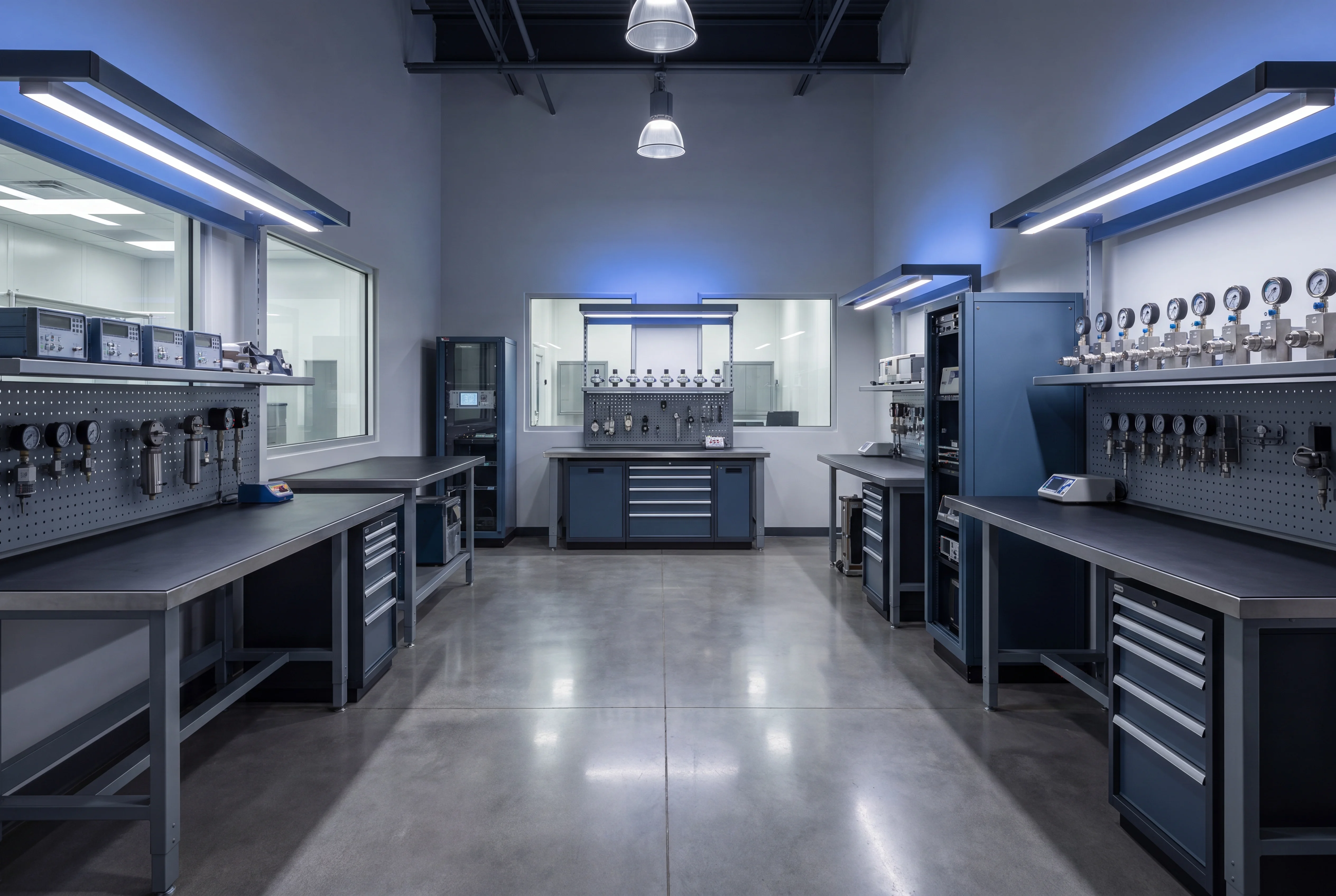
Diaphragm Differential Pressure Gauge Calibration
Diaphragm differential pressure gauges are critical instruments utilized for monitoring low-differential pressure applications, such as cleanroom environments, HVAC systems, and filter status. Because these instruments rely on the deflection of a flexible diaphragm to measure the difference between high and low pressure ports, rigorous calibration is required to detect mechanical wear, hysteresis, and sensor drift. Calibration of diaphragm-actuated instruments is performed using pneumatic deadweight testers or high-precision automated pressure controllers. Throughout the verification process, stable test pressures are applied to generate multi-point assessments across the specified operating range, typically measured in inches of water column (inH2O) or millibar (mbar).
To ensure documented reliability, differential pressure gauge calibration is conducted in accordance with ASME B40.100 guidelines and performed under ISO/IEC 17025 accreditation protocols. Standard verification procedures involve several key metrological assessments:
- Verification of zero-point accuracy and mechanical spanning adjustments.
- Multi-point linearity checks ascending and descending through the pressure scale to evaluate hysteresis.
- Leak testing of the high and low pressure cavities to verify diaphragm integrity.
- Generation of calibration certificates with full metrological traceability to NIST or equivalent national metrology institutes.
Magnehelic Differential Pressure Gauge Calibration
Calibration of Magnehelic differential pressure gauges is executed to ensure accurate measurement of low-pressure air and non-combustible gases across critical HVAC, cleanroom, and industrial environments. Because these instruments rely on sensitive diaphragm and magnetic linkage mechanisms to measure minor pressure differentials - typically ranging from fractions of an inch of water column (inH2O) to several pounds per square inch (psi) - meticulous procedural controls are necessary. The calibration process is performed using high-resolution digital reference manometers or micromanometers to generate precise low-pressure test points. Verification is conducted against documented manufacturer specifications or ASME B40.100 guidelines, typically requiring multi-point checks across the measurement span to evaluate linearity, hysteresis, and indication repeatability.
Measurement data is recorded to verify that instrument performance aligns with stringent operational tolerances. When necessary, internal zero and span adjustments are performed to bring the mechanical indicator back into acceptable operational status. Procedures are executed under controlled environmental conditions to mitigate temperature and ambient pressure variations that can induce significant errors in low-differential readings.
- Verification of diaphragm integrity and frictionless magnetic linkage movement.
- Multi-point pressure generation covering the full analog indicating scale.
- Metrological traceability established through NIST or equivalent National Metrology Institutes.
- Calibration protocols performed in strict accordance with ISO/IEC 17025 accreditation requirements.
Photohelic Differential Pressure Gauge Calibration
Photohelic differential pressure gauges integrate precise visual pressure indication with built-in relay switches for system control, requiring a dual-phase verification approach. Because these instruments serve both as monitors and active control elements in critical air or gas flow systems, calibration is performed to assess mechanical indication accuracy alongside electrical switch functionality. High-accuracy automated pressure controllers or standard reference manometers are utilized to generate stable, low-pressure differentials. These reference pressures are applied across the high and low ports to evaluate the instrument across its full operational range. Validation is performed under strict environmental controls and aligns with ISO/IEC 17025 accreditation parameters, ensuring all measurements maintain documented traceability to NIST.
The calibration protocol for photohelic instruments routinely encompasses the following technical evaluations:
- Verification of visual dial indication across multiple distributed points on the specific pressure scale.
- Actuation testing of high and low limit switches to determine exact set-point accuracy and repeatability.
- Measurement of the mechanical deadband, or hysteresis, during both rising and falling pressure cycles to verify relay stability.
- Zero-point verification, structural leak testing across the internal diaphragm assembly, and necessary mechanical span adjustments.
Technical Detail
Digihelic Differential Pressure Gauge Calibration
Calibration of digital differential pressure controllers, commonly known as digihelic gauges, encompasses both pneumatic pressure verification and electrical signal measurement. Because these instruments function simultaneously as a local indicating display, a 4-20 mA transmitter, and a dual-relay pressure switch, a comprehensive calibration protocol is required to ensure multi-variable accuracy. Low-differential pressure references are utilized to apply stable, controlled test media across the high and low pressure ports, targeting specific measurement ranges that are often scaled in inches of water column (in w.c.) or Pascals.
The calibration procedure for digihelic-style instruments typically includes:
- Verification of the digital display across a multi-point scale to assess linearity, repeatability, and hysteresis against a high-accuracy standard.
- Measurement of the analog 4-20 mA output signal using precision digital multimeters to confirm transmitter output accuracy.
- Testing of the solid-state control switches to ensure activation and deactivation occur strictly within the programmed setpoint tolerances.
- Application of necessary zero and span adjustments to correct output drift resulting from piezoresistive sensor fatigue or minor overpressure events.
All differential pressure measurements and concurrent electrical verifications are performed under strict ISO/IEC 17025 accreditation parameters, ensuring unbroken metrological traceability to the National Institute of Standards and Technology (NIST). Fully documented test data, complete with calculated measurement uncertainties, verifies that the controller meets the stringent tolerance limits required for critical cleanroom environments, HEPA filter monitoring, and complex industrial ventilation systems.
Differential Pressure & Magnehelic Gauge Calibration in Warren
The industrial landscape of Warren, Michigan, particularly along the Mound Road corridor and throughout Macomb County, is defined by high-density automotive research, defense engineering, and advanced manufacturing. Within this ecosystem, differential pressure measurement serves as a critical parameter for maintaining controlled atmospheres and ensuring the safety of heavy industrial operations. Facilities operating within this automotive and defense nucleus, including extensive research campuses like the General Motors Technical Center, rely heavily on precise airflow and pressure monitoring. Environmental testing chambers, aerodynamic wind tunnels, and engine dynamometer test cells require stringent control over air intake and exhaust pressures. Magnehelic gauges and digital differential pressure transmitters are deployed extensively throughout these specialized testing environments to provide continuous verification of air velocity and pressure drops, ensuring that extreme environmental simulations remain within strictly defined operational envelopes.
More on differential pressure & magnehelic gauge calibration in Warren
Beyond specialized research and development applications, large-scale assembly and manufacturing operations in Warren drive substantial demand for differential pressure calibration. Automotive production facilities, such as those near the Warren Truck Assembly plant, utilize massive industrial paint booths that require highly precise pressure gradients. Maintaining exact differential pressure is required to generate proper downdraft dynamics, which prevents particulate contamination from compromising exterior vehicle finishes and controls volatile organic compound (VOC) overspray. Furthermore, the region's dense concentration of metalworking, machining, and tooling facilities utilizes complex dust collection and baghouse filtration systems. In these environments, Magnehelic gauges provide immediate, visual confirmation of filter loading and pneumatic system efficiency. Continuous monitoring of pressure drops across these filtration banks is essential for preventing hazardous static pressure buildups and ensuring compliance with occupational safety thresholds regarding airborne metal particulates and machining dust.
Technical Compliance and Calibration Methodologies for Magnehelic Systems
Metrological confirmation of differential pressure instrumentation must align with the rigorous quality frameworks governing Warren's automotive and defense sectors. Calibration routines for Magnehelic gauges and low-pressure transmitters are executed in strict accordance with ISO/IEC 17025 accredited procedures, establishing an unbroken chain of measurement traceability to the National Institute of Standards and Technology (NIST). Because Magnehelic gauges operate via a purely mechanical, diaphragm-actuated mechanism coupled to a magnetic helix, calibration procedures must carefully evaluate the instrument for hysteresis, mechanical friction, and positional sensitivity. Routine calibration requires the application of highly stable pneumatic test pressures, typically measured in inches of water column (inH2O), utilizing precision reference standard digital pressure calibrators or specialized low-pressure deadweight testing systems. Measurements are recorded across both ascending and descending pressure scales to properly assess the dynamic responsiveness and zero-return characteristics of the mechanical linkage.
The acceptance criteria and tolerance grades applied during calibration are directly dictated by the regulatory environment of the installation site. Standard industrial Magnehelic gauges are typically verified against an accuracy specification of +/- 2 percent of full scale across their entire operating range. For automotive assembly plants operating high-volume spray booths, differential pressure instrumentation often falls under stringent environmental quality mandates. The Environmental Protection Agency's National Emission Standards for Hazardous Air Pollutants (NESHAP), specifically 40 CFR Part 63, necessitates documented, traceable verification of spray booth pressure drops to continuously validate emission capture efficiency. Similarly, manufacturing facilities operating combustible dust collection systems are governed by NFPA 652 standards, which mandate the routine functional verification and calibration of differential pressure interlocks. Ensuring these pneumatic gauges and electrical transmitters operate strictly within manufacturer specifications is critical for activating automated system shutdowns prior to potentially hazardous deflagration events in enclosed industrial spaces.
Related Services
Pressure Gauge Calibration
View in Warren ↗ RelatedDigital Pressure Gauge Calibration
View in Warren ↗ RelatedManometer Calibration
View in Warren ↗ RelatedPressure Transmitter, Transducer & Sensor Calibration
View in Warren ↗ RelatedPressure Switch & Relief Valve Calibration
View in Warren ↗ RelatedLeak Tester Calibration
View in Warren ↗Request differential pressure & magnehelic gauge calibration in Warren.
Submit instrument details to receive an itemized quote within one business day. NIST-traceable results, documented for audit and compliance.