Accredited Industrial Pressure Gauge Calibration in Sterling Heights, MI
Pressure Gauge Calibration in Sterling Heights, MI is performed by ISO/IEC 17025-accredited laboratories to recognized acceptance criteria, with documented uncertainty and NIST-traceable results.
Quote Pressure Gauge Calibration — Sterling Heights
Response within one business day
Service Overview
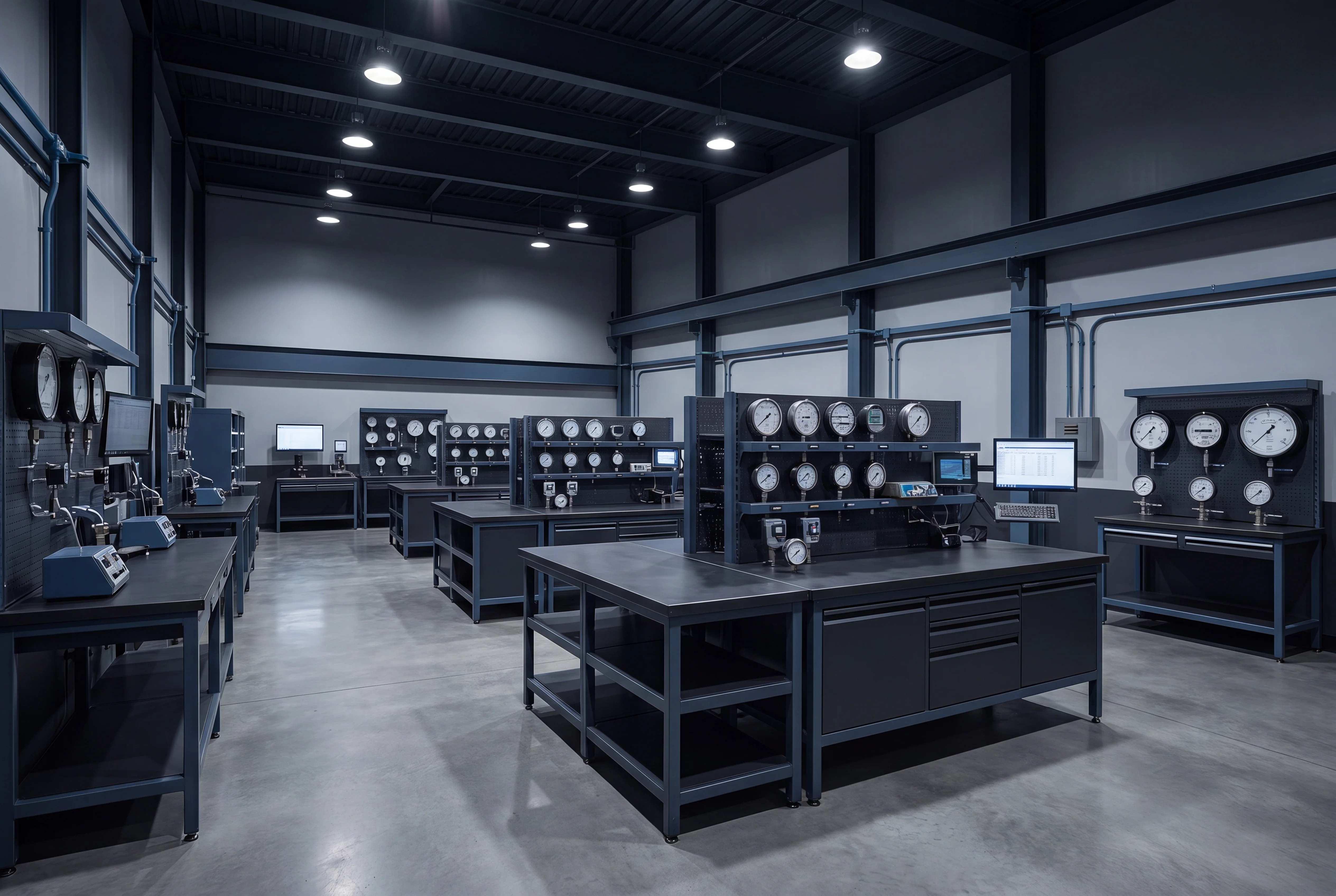
Bourdon Tube Pressure Gauge Calibration
Bourdon tube pressure gauge calibration requires precise control of environmental conditions and metrological traceability to address inherent physical characteristics such as hysteresis, linearity, and repeatability. Standard calibration processes are performed in accordance with ASME B40.100, which establishes accuracy grades, testing procedures, and permissible error limits for dial-indicating pressure gauges. Mechanical elements, including C-type, helical, or spiral Bourdon tubes, are subjected to controlled pressure increments and decrements to characterize elastic deformation behavior across the full scale of the instrument. To maintain compliance with ISO/IEC 17025 metrological requirements, the following parameters are systematically evaluated:
- Hysteresis and Repeatability: Measurement deviations are analyzed by comparing increasing and decreasing pressure cycles to identify material lag or mechanical wear.
- Linearity and Span: Calibration points are distributed across the gauge range to verify proportional pointer deflection and to adjust internal linkages if deviation exceeds specified tolerances.
- Friction and Tap Testing: The movement mechanism is evaluated before and after tapping the case to detect binding, gear wear, or excessive play in the segment and pinion.
- NIST-Traceable Reference Standards: Pressure generation is controlled using high-precision digital pressure controllers or deadweight testers, ensuring an appropriate test uncertainty ratio.
Diaphragm Pressure Gauge Calibration
Diaphragm pressure gauges are critical in low-pressure applications, sanitary processes, and highly corrosive environments where the process media must remain isolated from the measuring element. Calibration of these specialized instruments is performed to verify the structural integrity of the elastic diaphragm and the precision of the mechanical linkage transferring deflection to the pointer assembly. This metrological verification is executed in accordance with standards such as ASME B40.100 and Euramet cg-17, utilizing pneumatic or hydraulic pressure standards with direct NIST traceability.
Because diaphragm elements are susceptible to material fatigue, elastic hysteresis, and temperature-induced zero shifts, precise calibration procedures evaluate performance across multiple upscale and downscale points. The following parameters are systematically assessed during the process:
- Hysteresis and repeatability: Assessing variance in readings when pressure is increased versus decreased to identify potential material fatigue or mechanical binding.
- Linearity and conformity: Verifying that the non-linear displacement of the diaphragm translates uniformly across the graduated scale.
- Zero-point deviation: Quantifying shift anomalies caused by system overpressure or permanent set in the elastic element.
- Environmental thermal stability: Characterizing temperature-induced drift relative to calibrated reference baselines under controlled ambient conditions.
Pressure Gauge Calibration in Sterling Heights
The manufacturing ecosystem in Sterling Heights, Michigan, operates heavily on fluid power, generating substantial demand for verifiable pressure gauge calibration. Situated along the Mound Road industrial corridor and throughout Macomb County, facilities ranging from high-volume automotive assembly plants to defense mobility contractors rely on exact pressure measurements to maintain production continuity. Massive hydraulic stamping presses, such as those utilized in tier-one automotive body shop operations, require continuously calibrated pressure monitoring to ensure correct forming tonnages and prevent catastrophic die damage. Furthermore, the extensive pneumatic networks powering automated assembly lines, robotic weld cells, and advanced paint facilities at centers like the Stellantis Sterling Heights Assembly Plant (SHAP) and the Ford Van Dyke Electric Powertrain Center dictate absolute precision. In these environments, mechanical wear on bourdon tubes or drift in digital transducers due to constant pulsation, vibration, and occasional overpressure events is unavoidable. Regular calibration cycles serve as a fundamental requirement for operational stability. The integration of complex injection molding facilities supporting the automotive supply chain also demands tight control over hydraulic clamping pressures, where even minor gauge inaccuracies can result in severe plastic part defects such as flash or short shots.
More on pressure gauge calibration in Sterling Heights
Beyond commercial automotive production, the defense sector in Sterling Heights introduces an additional layer of rigor requiring stringent pressure calibration protocols. Facilities managed by major defense contractors, including General Dynamics Land Systems, utilize highly specialized hydraulic and pneumatic systems for armored vehicle development and testing. The validation of braking mechanisms, hydrostatic drives, and turret stabilization systems depends entirely on accurately calibrated pressure instrumentation. Supply chain flow-down requirements in this sector routinely mandate documented, uninterrupted measurement traceability. When pressure gauges drift out of tolerance, the resulting variations can lead to compromised mechanical assemblies, failed leak tests on critical powertrain components, or non-conformance reports during quality audits. The tooling and machining centers scattered throughout the local industrial parks also rely heavily on calibrated pressure gauges for coolant delivery systems and high-pressure part washing stations. Maintaining precise fluid delivery pressures ensures optimal tool life and surface finish on machined engine or transmission components. Consequently, the regional concentration of these high-stakes manufacturing environments sustains a continuous, volume-driven necessity for localized, technically rigorous calibration procedures that verify instrument accuracy against known reference standards.
Regulatory Frameworks and Calibration Methodologies
Pressure gauge calibration procedures must align with strict metrological standards and regulatory frameworks to ensure validity, particularly within the quality systems governing automotive and defense manufacturing. The primary standard dictating gauge accuracy and performance is ASME B40.100, which establishes specific tolerance grades ranging from Grade B (commonly utilized for general commercial equipment) to Grade 4A (mandated for high-precision laboratory testing). Calibration processes involve comparing the device under test against a superior reference standard, such as a deadweight tester or a high-accuracy digital pressure controller, ensuring unbroken traceability to the National Institute of Standards and Technology (NIST). To satisfy the rigorous requirements of ISO/IEC 17025 accredited quality management systems, these comparisons are typically conducted across the entire operational range of the gauge. Standard methodology dictates capturing readings at minimum intervals of 20, 40, 60, 80, and 100 percent of full scale, in both ascending and descending directions. This bidirectional testing is critical for identifying hysteresis, repeatability errors, and non-linearity within the internal mechanisms of the instrument. Different calibration media are selected based on the specific application of the gauge; pneumatic comparators utilizing dry, filtered nitrogen are essential for calibrating gauges intended for cleanroom or breathable gas applications, whereas specialized hydraulic fluids are employed for high-pressure industrial systems up to and exceeding 10,000 psi. The calibration of differential pressure transmitters and absolute pressure gauges requires further specialized manifold configurations to accurately simulate operational parameters without introducing environmental variables.
Facilities operating in the Sterling Heights automotive corridor are generally governed by IATF 16949, an international standard that places heavy emphasis on Measurement Systems Analysis (MSA) and comprehensive equipment calibration. Under this framework, any pressure gauge utilized to verify product quality or control a manufacturing process must be subject to a strictly documented calibration schedule. Acceptance criteria are typically established based on a Test Uncertainty Ratio (TUR) of 4:1 or greater, ensuring the reference standard is significantly more accurate than the instrument being evaluated. If a gauge is discovered to be out of tolerance during a scheduled verification, severe compliance protocols are triggered, often requiring a retroactive investigation into all manufactured products validated by that specific instrument since its last successful calibration. For defense applications, adherence to ANSI/NCSL Z540.1 or ISO 10012 is frequently required, further enforcing environmental controls in the metrology laboratory, precise calculation of measurement uncertainty, and rigorous documentation of exact as-found and as-left tolerance states. Strict environmental monitoring within the calibration environment is necessary, as ambient temperature fluctuations can significantly alter the elasticity of a metallic bourdon tube or the resistance values of a piezoresistive sensor, thereby skewing the calibration data. Accurate documentation must detail every environmental parameter, calibration standard utilized, and the exact deviation from the nominal value, providing the total quality assurance demanded by regional industrial operations.
Related Services
Digital Pressure Gauge Calibration
View in Sterling Heights ↗ RelatedManometer Calibration
View in Sterling Heights ↗ RelatedPressure Transmitter, Transducer & Sensor Calibration
View in Sterling Heights ↗ RelatedPressure Switch & Relief Valve Calibration
View in Sterling Heights ↗ RelatedLeak Tester Calibration
View in Sterling Heights ↗ RelatedPiston Gauge Calibration
View in Sterling Heights ↗Request pressure gauge calibration in Sterling Heights.
Submit instrument details to receive an itemized quote within one business day. NIST-traceable results, documented for audit and compliance.