Accredited Industrial Pressure Gauge Calibration in Rockford, IL
Pressure Gauge Calibration in Rockford, IL is performed by ISO/IEC 17025-accredited laboratories to recognized acceptance criteria, with documented uncertainty and NIST-traceable results.
Quote Pressure Gauge Calibration — Rockford
Response within one business day
Service Overview
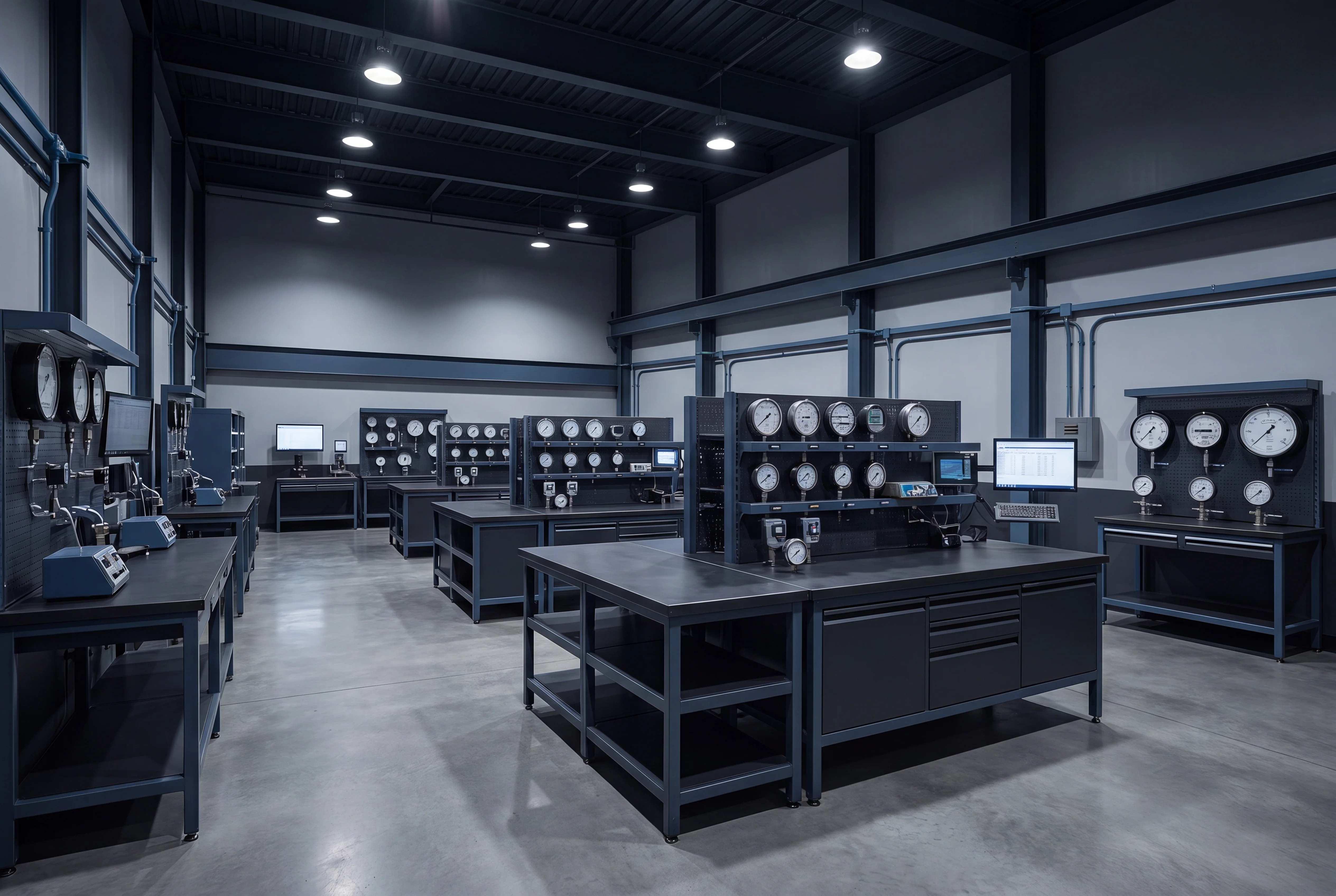
Bourdon Tube Pressure Gauge Calibration
Bourdon tube pressure gauge calibration requires precise control of environmental conditions and metrological traceability to address inherent physical characteristics such as hysteresis, linearity, and repeatability. Standard calibration processes are performed in accordance with ASME B40.100, which establishes accuracy grades, testing procedures, and permissible error limits for dial-indicating pressure gauges. Mechanical elements, including C-type, helical, or spiral Bourdon tubes, are subjected to controlled pressure increments and decrements to characterize elastic deformation behavior across the full scale of the instrument. To maintain compliance with ISO/IEC 17025 metrological requirements, the following parameters are systematically evaluated:
- Hysteresis and Repeatability: Measurement deviations are analyzed by comparing increasing and decreasing pressure cycles to identify material lag or mechanical wear.
- Linearity and Span: Calibration points are distributed across the gauge range to verify proportional pointer deflection and to adjust internal linkages if deviation exceeds specified tolerances.
- Friction and Tap Testing: The movement mechanism is evaluated before and after tapping the case to detect binding, gear wear, or excessive play in the segment and pinion.
- NIST-Traceable Reference Standards: Pressure generation is controlled using high-precision digital pressure controllers or deadweight testers, ensuring an appropriate test uncertainty ratio.
Diaphragm Pressure Gauge Calibration
Diaphragm pressure gauges are critical in low-pressure applications, sanitary processes, and highly corrosive environments where the process media must remain isolated from the measuring element. Calibration of these specialized instruments is performed to verify the structural integrity of the elastic diaphragm and the precision of the mechanical linkage transferring deflection to the pointer assembly. This metrological verification is executed in accordance with standards such as ASME B40.100 and Euramet cg-17, utilizing pneumatic or hydraulic pressure standards with direct NIST traceability.
Because diaphragm elements are susceptible to material fatigue, elastic hysteresis, and temperature-induced zero shifts, precise calibration procedures evaluate performance across multiple upscale and downscale points. The following parameters are systematically assessed during the process:
- Hysteresis and repeatability: Assessing variance in readings when pressure is increased versus decreased to identify potential material fatigue or mechanical binding.
- Linearity and conformity: Verifying that the non-linear displacement of the diaphragm translates uniformly across the graduated scale.
- Zero-point deviation: Quantifying shift anomalies caused by system overpressure or permanent set in the elastic element.
- Environmental thermal stability: Characterizing temperature-induced drift relative to calibrated reference baselines under controlled ambient conditions.
Pressure Gauge Calibration in Rockford
More on pressure gauge calibration in Rockford
Aerospace and Heavy Manufacturing Drivers in the Rock River Valley
The industrial corridor encompassing Rockford, Illinois, and greater Winnebago County represents a dense concentration of aerospace component manufacturing, heavy machinery production, and advanced logistics operations. Facilities clustered around the Chicago Rockford International Airport and along the Interstate 90 corridor rely extensively on complex hydraulic and pneumatic systems. Within these environments, pressure gauge calibration serves as a critical maintenance parameter rather than a secondary operational concern. Tier-1 aerospace suppliers, which historically anchor the regional economy, operate intricate test stands simulating high-altitude atmospheric conditions and hydraulic fluid pressures for flight control actuation systems. These specialized rigs depend entirely on the accuracy of differential and absolute pressure transmitters to validate component performance prior to airframe integration. Any undocumented drift in pressure readings compromises the rigorous safety margins dictated by civil and military aviation authorities. Beyond the primary aerospace sector, Rockford's enduring reputation as a center for specialized fastener production and automotive assembly generates continuous demand for analog and digital pressure metrology. Heavy stamping presses, extrusion machinery, and CNC machining centers utilize pressure gauges to monitor coolant lines, hydraulic clamping forces, and pneumatic actuation. In local industrial parks extending into Loves Park and Machesney Park, manufacturing facilities operate under strict continuous improvement models where process variation must be mathematically minimized. Unverified pressure instruments introduce silent errors into production runs, potentially leading to out-of-tolerance parts, accelerated tooling wear, or catastrophic equipment failure. Scheduled verification of Bourdon tube gauges, pressure transducers, and vacuum sensors ensures that operational pressures align exactly with programmed setpoints, safeguarding both product geometry and workplace safety.Metrological Traceability and Regional Compliance Standards
Facilities operating within the Rockford aerospace supply chain are strictly bound by AS9100 quality management systems, which explicitly mandate the control, maintenance, and rigorous calibration of all monitoring and measuring equipment. Pressure gauge calibration performed for these regional manufacturers must demonstrate unbroken, documented traceability to the National Institute of Standards and Technology (NIST) and comply with ISO/IEC 17025 general requirements for the competence of testing and calibration laboratories. Regulatory frameworks require that calibration protocols follow recognized consensus standards, most notably ASME B40.100 for dial indicating pressure gauges. This specific standard classifies instruments by accuracy grades, ranging from Grade B for general utility applications to Grade 4A for high-precision laboratory test gauges requiring limits of error as tight as 0.1 percent of full scale span. The actual execution of pressure metrology requires strict adherence to defined environmental and procedural controls to mitigate measurement uncertainty. Methodologies typically involve generating known pressures using deadweight testers or highly stable digital automated pressure controllers, then recording the response of the device under test across multiple cardinal points. During these procedures, technicians meticulously document hysteresis - the difference in gauge indication when approaching a specific pressure from an increasing versus a decreasing direction - alongside repeatability and linearity metrics. Furthermore, calibration media selection must align with the end-use environment of the Rockford-based facility. Gauges utilized in cleanroom aerospace applications require calibration using clean, dry nitrogen to prevent hydrocarbon contamination, while instruments designated for heavy industrial presses are evaluated utilizing specialized hydraulic fluids. Regulatory scrutiny within these industrial sectors extends significantly beyond initial accuracy verifications. Facilities must establish scientifically valid calibration intervals based on historical drift data, manufacturer recommendations, and the severity of the operational environment. In the heavy manufacturing sectors typical of Winnebago County, gauges subjected to severe mechanical vibration, high-frequency pressure pulsations, or corrosive media frequently require shortened verification intervals and the installation of protective accessories such as snubbers or diaphragm seals. Quality inspectors operating under ISO 9001 frameworks consistently review out-of-tolerance reports to mathematically determine if manufacturing processes were compromised during the period between calibrations. Comprehensive calibration certificates generated from these procedures provide the defensible, documented evidence required during intensive third-party quality audits.Related Services
Digital Pressure Gauge Calibration
View in Rockford ↗ RelatedManometer Calibration
View in Rockford ↗ RelatedPressure Transmitter, Transducer & Sensor Calibration
View in Rockford ↗ RelatedPressure Switch & Relief Valve Calibration
View in Rockford ↗ RelatedLeak Tester Calibration
View in Rockford ↗ RelatedPiston Gauge Calibration
View in Rockford ↗Request pressure gauge calibration in Rockford.
Submit instrument details to receive an itemized quote within one business day. NIST-traceable results, documented for audit and compliance.