Accredited Industrial Pressure Gauge Calibration in Minneapolis, MN
Pressure Gauge Calibration in Minneapolis, MN is performed by ISO/IEC 17025-accredited laboratories to recognized acceptance criteria, with documented uncertainty and NIST-traceable results.
Quote Pressure Gauge Calibration — Minneapolis
Response within one business day
Service Overview
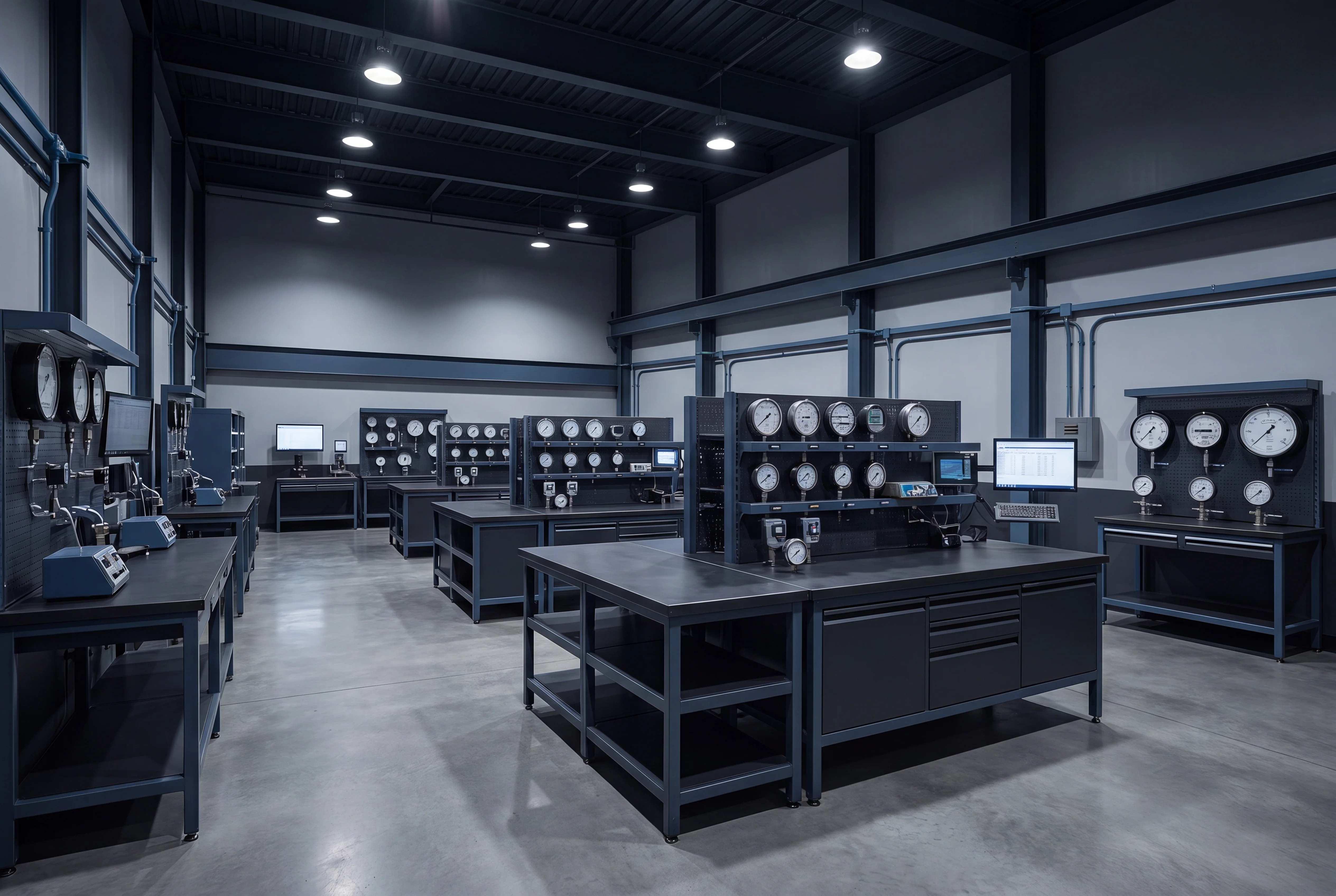
Bourdon Tube Pressure Gauge Calibration
Bourdon tube pressure gauge calibration requires precise control of environmental conditions and metrological traceability to address inherent physical characteristics such as hysteresis, linearity, and repeatability. Standard calibration processes are performed in accordance with ASME B40.100, which establishes accuracy grades, testing procedures, and permissible error limits for dial-indicating pressure gauges. Mechanical elements, including C-type, helical, or spiral Bourdon tubes, are subjected to controlled pressure increments and decrements to characterize elastic deformation behavior across the full scale of the instrument. To maintain compliance with ISO/IEC 17025 metrological requirements, the following parameters are systematically evaluated:
- Hysteresis and Repeatability: Measurement deviations are analyzed by comparing increasing and decreasing pressure cycles to identify material lag or mechanical wear.
- Linearity and Span: Calibration points are distributed across the gauge range to verify proportional pointer deflection and to adjust internal linkages if deviation exceeds specified tolerances.
- Friction and Tap Testing: The movement mechanism is evaluated before and after tapping the case to detect binding, gear wear, or excessive play in the segment and pinion.
- NIST-Traceable Reference Standards: Pressure generation is controlled using high-precision digital pressure controllers or deadweight testers, ensuring an appropriate test uncertainty ratio.
Diaphragm Pressure Gauge Calibration
Diaphragm pressure gauges are critical in low-pressure applications, sanitary processes, and highly corrosive environments where the process media must remain isolated from the measuring element. Calibration of these specialized instruments is performed to verify the structural integrity of the elastic diaphragm and the precision of the mechanical linkage transferring deflection to the pointer assembly. This metrological verification is executed in accordance with standards such as ASME B40.100 and Euramet cg-17, utilizing pneumatic or hydraulic pressure standards with direct NIST traceability.
Because diaphragm elements are susceptible to material fatigue, elastic hysteresis, and temperature-induced zero shifts, precise calibration procedures evaluate performance across multiple upscale and downscale points. The following parameters are systematically assessed during the process:
- Hysteresis and repeatability: Assessing variance in readings when pressure is increased versus decreased to identify potential material fatigue or mechanical binding.
- Linearity and conformity: Verifying that the non-linear displacement of the diaphragm translates uniformly across the graduated scale.
- Zero-point deviation: Quantifying shift anomalies caused by system overpressure or permanent set in the elastic element.
- Environmental thermal stability: Characterizing temperature-induced drift relative to calibrated reference baselines under controlled ambient conditions.
Pressure Gauge Calibration in Minneapolis
The industrial infrastructure throughout Minneapolis and the greater Twin Cities metropolitan area generates substantial baseline demand for pressure gauge calibration. Within the Mid-City Industrial Area and advanced manufacturing corridors flanking Interstate 94, continuous production environments rely heavily on precise pressure measurement to maintain process control. Facilities operating in these districts utilize vast networks of analog and digital pressure gauges to monitor hydraulic presses, pneumatic conveying systems, and high-pressure steam lines. The regional supply chains supporting heavy machinery fabrication and precision aerospace component manufacturing require strict adherence to pressure specifications to ensure part integrity and operational safety. In these high-vibration environments, mechanical gauges are susceptible to drift and component wear, necessitating systematic metrological verification to prevent catastrophic process failures.
More on pressure gauge calibration in Minneapolis
The prominent concentration of medical device manufacturing and commercial food processing throughout Hennepin County establishes uniquely rigorous operational requirements for pressure instrumentation. Production lines managing sanitary processing for global agricultural conglomerates, alongside stringent cleanroom environments maintained by medical technology developers, demand routine calibration of specialized sanitary pressure gauges and transmitters. Operational pressures within these facilities dictate that measurement devices must not deviate beyond narrowly defined tolerances. Inaccurate pressure readings during automated manufacturing sequences can directly compromise sterilization efficacy, fluid flow calculations, and material strength validations. Consequently, the localized manufacturing ecosystem in Minneapolis requires a continuous cycle of instrument testing to sustain production output and mitigate the risks associated with out-of-tolerance pressure events.
Technical and Compliance Context for Pressure Instrumentation
Pressure gauge calibration is governed by explicit metrological standards designed to ensure measurement repeatability, linearity, and overall accuracy. Testing methodologies typically align with the parameters defined in ASME B40.100, which establishes the accuracy grades, construction requirements, and evaluation protocols for dial-type pressure indicating instruments. The core metrological verification process involves isolating the instrument from process variables and comparing its output against a high-precision reference standard, such as a deadweight tester or a digital pressure comparator. An unbroken chain of documentation must be maintained to establish NIST traceability, verifying that the reference standards themselves are calibrated against fundamental physical constants. This hierarchical traceability is a baseline requirement for any Minneapolis facility holding ISO/IEC 17025 accreditation or operating under comprehensive ISO 9001 quality management systems.
For the highly regulated medical technology and food processing sectors operating within the region, pressure instrumentation is heavily scrutinized under federal compliance frameworks. Manufacturing facilities producing Class II and Class III medical devices must maintain strict alignment with FDA 21 CFR Part 820 quality system regulations, while biological and pharmaceutical operations are bound by FDA 21 CFR Part 211. These regulatory structures mandate meticulously documented calibration intervals and rigid acceptance criteria for all pressure gauges deployed in critical control points, including autoclave sterilization chambers, clean-in-place (CIP) systems, and specialized extrusion equipment. Metrological evaluation for these applications demands precise documentation of "as-found" and "as-left" data to verify ongoing compliance and support comprehensive audit trails.
Calibration tolerances are systematically assigned based on the instrument's designated grade and its intended application within the process loop. High-precision testing environments typically utilize Grade 3A gauges, which require an accuracy of 0.25 percent of the measurement span across the entire scale. Conversely, general industrial monitoring applications may employ Grade B gauges, which permit a 3-2-3 percent variance depending on the position of the pointer on the dial. The physical calibration procedure involves applying incremental, known pressure values across the full operational range of the device, systematically observing the mechanical or digital response. The verification process calculates the measurement deviation and assesses the instrument for hysteresis - the difference in readings when approaching a pressure point from an ascending versus a descending direction. If a gauge operates outside its specified tolerance band, mechanical adjustments to the bourdon tube linkage or digital zero-span corrections are applied to restore functional compliance.
Related Services
Digital Pressure Gauge Calibration
View in Minneapolis ↗ RelatedManometer Calibration
View in Minneapolis ↗ RelatedPressure Transmitter, Transducer & Sensor Calibration
View in Minneapolis ↗ RelatedPressure Switch & Relief Valve Calibration
View in Minneapolis ↗ RelatedLeak Tester Calibration
View in Minneapolis ↗ RelatedPiston Gauge Calibration
View in Minneapolis ↗Request pressure gauge calibration in Minneapolis.
Submit instrument details to receive an itemized quote within one business day. NIST-traceable results, documented for audit and compliance.