Accredited Industrial Manometer Calibration in Michigan
Manometer Calibration in Michigan is performed by ISO/IEC 17025-accredited laboratories to recognized acceptance criteria, with documented uncertainty and NIST-traceable results.
Quote Manometer Calibration — Michigan
Response within one business day
Service Overview
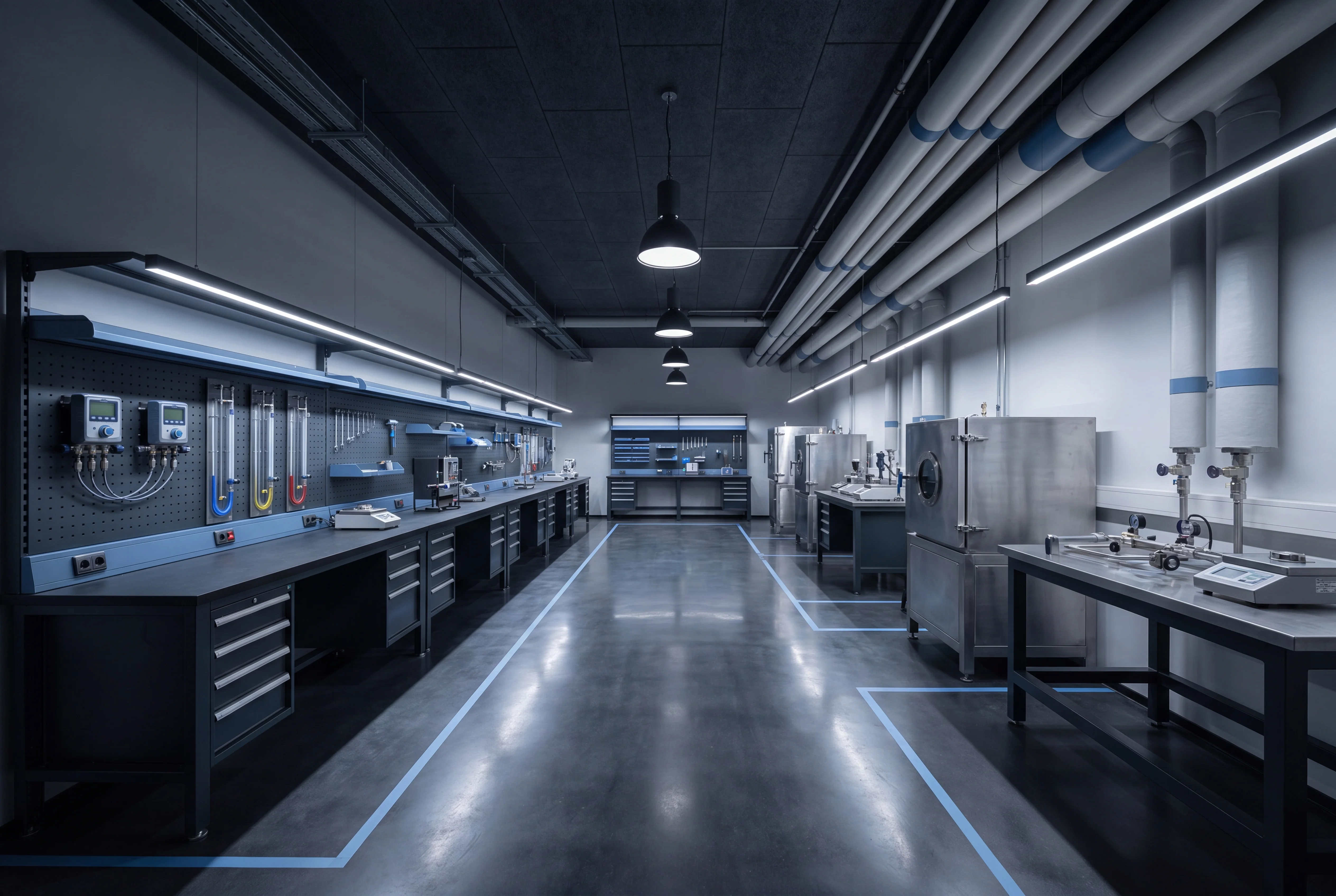
U-tube Manometer Calibration
Calibration of U-tube manometers requires rigorous evaluation of both the primary measurement scale and the fluid dynamics that dictate the indicated pressure. Because these instruments rely on the physical displacement of a liquid column - typically utilizing water, mercury, or proprietary gauge fluids - the calibration process must meticulously account for environmental variables that directly alter fluid density and hydrostatic equilibrium. Calibration is performed under ISO/IEC 17025 accreditation protocols to ensure documented measurement traceability to national metrology standards, such as those maintained by NIST. The verification procedure involves applying highly stable reference pressures using precision automated controllers or deadweight testers, subsequently comparing the standard against the manometer's observed differential height.
Critical parameters evaluated during this calibration sequence include:
- Verification of scale linearity, absolute zero-point alignment, and graduation accuracy across the entire operational range.
- Application of critical temperature corrections, as thermal expansion continuously alters the specific gravity of the indicating fluid.
- Mathematical compensation for local gravity variations, which fundamentally impact the primary hydrostatic pressure calculation.
- Inspection of the bore tubing for internal contamination or surface tension anomalies that could distort the meniscus and induce parallax reading errors.
- Pneumatic leak testing of the manifold and connection fittings to confirm absolute system integrity under sustained static pressure.
Digital Manometer Calibration
Digital manometer calibration is performed under strict ISO/IEC 17025 accredited procedures to ensure the integrity of electronic pressure measurements. Unlike liquid-column counterparts, digital manometers rely on piezoresistive or silicon capacitive sensors, which require precise voltage-to-pressure correlation. High-accuracy pneumatic or hydraulic comparators are utilized alongside NIST-traceable reference standards to evaluate the device across its full operating range. The calibration process involves multi-point verification to analyze key performance characteristics:
- Hysteresis and Linearity: Assessment of sensor response during both increasing and decreasing pressure cycles to identify deviations in the transducer element.
- Repeatability: Evaluation of the instrument's ability to provide consistent readings under identical pressure conditions.
- Zero and Span Adjustment: Corrections applied to align the digital output with reference standards at both zero pressure and full-scale limits.
- Temperature Effects: Verification of thermal compensation stability, as digital sensors are susceptible to drift caused by ambient temperature fluctuations.
All measurements are conducted in accordance with ASME B40.7 standards, providing documented test uncertainty ratios (TUR) to support industrial compliance and quality management systems.
Manometer Calibration in Michigan
Differential pressure measurement represents a critical operational parameter for the massive concentration of automotive, aerospace, and pharmaceutical industries located throughout Michigan. Within the automotive research and development hubs spanning Oakland and Macomb counties, engineering facilities rely extensively on highly accurate manometers to map aerodynamic profiles and analyze intake airflow constraints. Wind tunnel testing facilities in Allen Park and engine dynamometer cells in Pontiac utilize both digital and precision liquid manometers to verify pitot-static tube readings. Because fuel efficiency and thermal management are optimized based on these subtle pressure differentials, baseline accuracy must be strictly maintained. Any deviation or drift in the measurement instruments can invalidate extensive periods of aerodynamic data collection. Additionally, the testing of commercial aerospace components within the Ann Arbor research corridor requires extremely sensitive measurement of airflow velocity, further driving the necessity for robust, localized pressure metrology.
More on manometer calibration in Michigan
Beyond the mobility sector, pharmaceutical manufacturing clusters in western Michigan, particularly those operating near Kalamazoo, generate substantial demand for rigorous manometer calibration. Cleanroom environments within these life science facilities utilize stationary differential pressure instruments to verify positive pressure cascading between controlled manufacturing zones. Maintaining specific pressure differentials is necessary to prevent airborne cross-contamination during active pharmaceutical ingredient processing. Accurate manometer readings ensure that high-efficiency particulate air filtration systems are functioning within established operational limits.
Furthermore, heavy manufacturing plants and assembly complexes in the Grand Rapids area depend on manometers to monitor exhaust filter loading in industrial paint booths. Inaccurate monitoring in these environments can lead to volatile organic compound accumulation, disrupted spray patterns, and subsequent environmental or safety violations. Industrial HVAC systems within large-scale commercial centers in downtown Detroit also rely on routinely calibrated manometers to balance complex air distribution networks, ensuring energy efficiency and proper ventilation rates for high-occupancy structures.
Technical Standards and Metrological Compliance Context
Calibration procedures for both digital and liquid-column manometers must establish unbroken metrological traceability to the National Institute of Standards and Technology (NIST) or an equivalent National Metrology Institute. Under the operational guidelines of ISO/IEC 17025, pressure metrology laboratories must control environmental variables strictly, as temperature fluctuations directly impact fluid density and electronic sensor stability. For high-precision liquid manometers, physical procedures must account for local gravity variations across Michigan latitudes to establish exact baseline zero points and accurate scale linearity. Digital instruments undergo rigorous multipoint calibration routines, typically compared against precision pneumatic pressure controllers or deadweight testers. A standard calibration profile for a digital manometer often includes a minimum of five test points across the instrument's operational range, applying pressure in both ascending and descending increments to properly map hysteresis behavior and measurement repeatability.
Facilities operating under federal regulatory frameworks face stringent compliance requirements regarding their pressure measurement instrumentation. Life science and pharmaceutical sites must adhere to FDA 21 CFR Part 211, which mandates that all mechanical and electronic equipment utilized in manufacturing processes be routinely calibrated according to a formalized, written program. In the environmental compliance sector, industrial stack testing across Michigan's heavy manufacturing baseline utilizes manometers in conjunction with EPA Method 2 for the determination of stack gas velocity and volumetric flow rates. This testing requires precise differential pressure readings across an S-type pitot tube, making the calibration accuracy of the manometer directly tied to the validity of the emissions data reported to state and federal environmental protection agencies.
To satisfy these regulatory parameters and strict acceptance criteria, formal calibration documentation must be generated containing specific elements required by compliance auditors:
- Precise calculations of measurement uncertainty accounting for laboratory environmental variables.
- Identification of the specific reference standards utilized during the evaluation to prove NIST traceability.
- Documented "as found" and "as left" data points to track instrument drift and validate historical readings.
Acceptance criteria vary depending on the industrial application, but tolerance grades for critical environmental monitoring manometers frequently require resolutions of 0.05 inches of water column or better. Calibration parameters are governed by general metrology standards such as ANSI/NCSL Z540-1 and Z540.3, ensuring that the test uncertainty ratio remains adequate to validate the instrument's performance specifications. Proper execution of these metrological methods ensures that industrial facilities maintain the necessary accuracy for strict regulatory audits and ongoing process safety.
Related Services
Pressure Gauge Calibration
View in Michigan ↗ RelatedDigital Pressure Gauge Calibration
View in Michigan ↗ RelatedPressure Transmitter, Transducer & Sensor Calibration
View in Michigan ↗ RelatedPressure Switch & Relief Valve Calibration
View in Michigan ↗ RelatedLeak Tester Calibration
View in Michigan ↗ RelatedPiston Gauge Calibration
View in Michigan ↗Request manometer calibration in Michigan.
Submit instrument details to receive an itemized quote within one business day. NIST-traceable results, documented for audit and compliance.