Accredited Industrial Pressure Gauge Calibration in Lansing, MI
Pressure Gauge Calibration in Lansing, MI is performed by ISO/IEC 17025-accredited laboratories to recognized acceptance criteria, with documented uncertainty and NIST-traceable results.
Quote Pressure Gauge Calibration — Lansing
Response within one business day
Service Overview
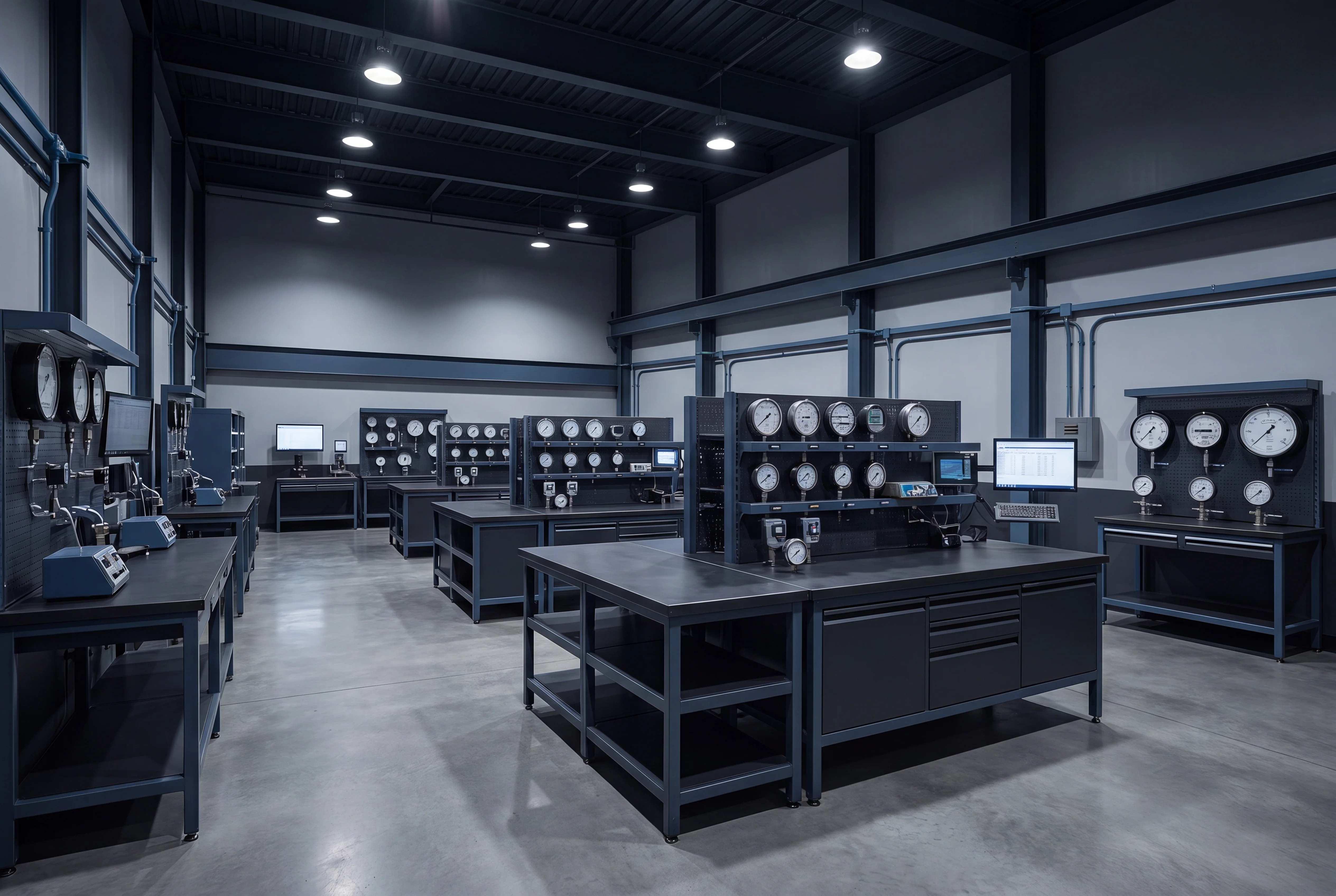
Bourdon Tube Pressure Gauge Calibration
Bourdon tube pressure gauge calibration requires precise control of environmental conditions and metrological traceability to address inherent physical characteristics such as hysteresis, linearity, and repeatability. Standard calibration processes are performed in accordance with ASME B40.100, which establishes accuracy grades, testing procedures, and permissible error limits for dial-indicating pressure gauges. Mechanical elements, including C-type, helical, or spiral Bourdon tubes, are subjected to controlled pressure increments and decrements to characterize elastic deformation behavior across the full scale of the instrument. To maintain compliance with ISO/IEC 17025 metrological requirements, the following parameters are systematically evaluated:
- Hysteresis and Repeatability: Measurement deviations are analyzed by comparing increasing and decreasing pressure cycles to identify material lag or mechanical wear.
- Linearity and Span: Calibration points are distributed across the gauge range to verify proportional pointer deflection and to adjust internal linkages if deviation exceeds specified tolerances.
- Friction and Tap Testing: The movement mechanism is evaluated before and after tapping the case to detect binding, gear wear, or excessive play in the segment and pinion.
- NIST-Traceable Reference Standards: Pressure generation is controlled using high-precision digital pressure controllers or deadweight testers, ensuring an appropriate test uncertainty ratio.
Diaphragm Pressure Gauge Calibration
Diaphragm pressure gauges are critical in low-pressure applications, sanitary processes, and highly corrosive environments where the process media must remain isolated from the measuring element. Calibration of these specialized instruments is performed to verify the structural integrity of the elastic diaphragm and the precision of the mechanical linkage transferring deflection to the pointer assembly. This metrological verification is executed in accordance with standards such as ASME B40.100 and Euramet cg-17, utilizing pneumatic or hydraulic pressure standards with direct NIST traceability.
Because diaphragm elements are susceptible to material fatigue, elastic hysteresis, and temperature-induced zero shifts, precise calibration procedures evaluate performance across multiple upscale and downscale points. The following parameters are systematically assessed during the process:
- Hysteresis and repeatability: Assessing variance in readings when pressure is increased versus decreased to identify potential material fatigue or mechanical binding.
- Linearity and conformity: Verifying that the non-linear displacement of the diaphragm translates uniformly across the graduated scale.
- Zero-point deviation: Quantifying shift anomalies caused by system overpressure or permanent set in the elastic element.
- Environmental thermal stability: Characterizing temperature-induced drift relative to calibrated reference baselines under controlled ambient conditions.
Pressure Gauge Calibration in Lansing
The manufacturing and research corridors of Lansing, Michigan, represent a concentrated zone of advanced industrial activity requiring rigorous pressure gauge calibration. Centered around Ingham County and the intersecting logistics networks of I-96 and I-69, the local industrial economy is anchored by high-volume automotive assembly operations, specialized tier-one automotive suppliers, and expanding biotechnology sectors. Automotive production facilities, such as the expansive complexes situated in the Lansing Delta Township and the Lansing Grand River assembly areas, rely heavily on extensive pneumatic automation networks, hydraulic stamping presses, and robotic fluid dispensing systems. Within these demanding environments, analog and digital pressure gauges serve as critical process monitors. Variations in compressed air supply pressure can lead to pneumatic torque tool deviations and robotic actuation failures along the assembly line. Furthermore, uncalibrated hydraulic gauges on heavy stamping presses risk equipment degradation, operator safety hazards, or structural variations in critical metal components. Consequently, facility managers and process engineers throughout the Greater Lansing manufacturing hubs require strict adherence to instrumentation maintenance schedules to ensure continuous, safe, and efficient facility operations without unplanned downtime.
More on pressure gauge calibration in Lansing
Beyond heavy automotive manufacturing, the Lansing metropolitan area supports a robust life sciences, agricultural technology, and pharmaceutical research ecosystem. This sector is driven significantly by proximity to Michigan State University and surrounding technology incubators. Facilities engaged in bioprocessing, pharmaceutical scale-up, agricultural diagnostics, and chemical formulation utilize highly specialized sanitary pressure gauges, differential pressure transmitters, and critical gas delivery manifolds. These operations face intense regulatory scrutiny and strict operational protocols to maintain pristine environmental controls and exact process variables. Cleanroom facilities in local research parks depend on precisely calibrated differential pressure gauges, such as Magnehelic or Photohelic instruments, to verify positive pressure cascading environments that prevent airborne cross-contamination. Similarly, advanced bioreactors, lyophilization units, and filtration skids require the frequent verification of diaphragm-sealed process gauges to ensure batch integrity, optimize yields, and prevent over-pressurization during aggressive steam-in-place or clean-in-place sterilization cycles. The diversity of these local industries necessitates a highly adaptive approach to pressure metrology across a wide spectrum of pressure ranges, from deep vacuum to extreme high-pressure hydraulics.
Metrology Standards and Compliance Frameworks for Pressure Devices
The verification of pressure measurement instruments within Lansing industrial facilities is strictly governed by established metrological standards, primarily ASME B40.100. This fundamental standard dictates the design requirements, testing protocols, and accuracy grading for dial-type analog pressure gauges and digital process indicators. Depending on the specific industrial application, mechanical engineers specify instruments across various tolerance grades, from Grade B (3/2/3 percent of span) for general utility applications like cooling water lines, to Grade 4A (0.1 percent of span) for critical laboratory test equipment. Calibration procedures require comparing the instrument under test against a highly accurate reference standard, typically a pneumatic or hydraulic deadweight tester, or a precision digital pressure calibrator. These reference standards must maintain an unbroken, documented chain of traceability to the National Institute of Standards and Technology (NIST). The physical calibration process involves carefully exercising the mechanical sensing elements, such as the Bourdon tube or bellows, across the full operational scale. This mitigates mechanical stress before technicians record multiple ascending and descending pressure data points. This methodical procedure isolates and captures potential errors related to mechanical hysteresis, repeatability, and friction that could compromise measurement validity in field applications.
Furthermore, the regulatory frameworks specific to the core economic sectors in Lansing mandate rigorous quality management systems that dictate calibration intervals and statistical acceptance criteria. Automotive suppliers and assembly plants operating under IATF 16949 quality management requirements must demonstrate that all measurement and test equipment used to verify product conformance is calibrated against recognized international standards. Out-of-tolerance conditions discovered during routine gauge verification trigger mandatory, extensive root-cause investigations to determine if the compromised pressure data adversely affected the structural integrity or performance of manufactured automotive components. Concurrently, life sciences and pharmaceutical manufacturers operating in Ingham County must strictly adhere to federal guidelines, specifically FDA 21 CFR Part 211 and Part 11 for electronic records. These federal regulations mandate that all analytical and process control instrumentation be routinely calibrated at suitable, scientifically justified intervals in accordance with validated, written procedures. To support these specialized industrial sectors, metrology laboratories must operate in comprehensive alignment with ISO/IEC 17025 accreditation standards. This requires the utilization of validated calculation methods for measurement uncertainty, factoring in local gravity and temperature compensations, and applying rigorous guardbanding techniques per ILAC-G8 guidelines to ensure conformity decisions are statistically robust and compliant with global auditing requirements.
Related Services
Digital Pressure Gauge Calibration
View in Lansing ↗ RelatedManometer Calibration
View in Lansing ↗ RelatedPressure Transmitter, Transducer & Sensor Calibration
View in Lansing ↗ RelatedPressure Switch & Relief Valve Calibration
View in Lansing ↗ RelatedLeak Tester Calibration
View in Lansing ↗ RelatedPiston Gauge Calibration
View in Lansing ↗Request pressure gauge calibration in Lansing.
Submit instrument details to receive an itemized quote within one business day. NIST-traceable results, documented for audit and compliance.