Accredited Industrial Manometer Calibration in Dubuque, IA
Manometer Calibration in Dubuque, IA is performed by ISO/IEC 17025-accredited laboratories to recognized acceptance criteria, with documented uncertainty and NIST-traceable results.
Quote Manometer Calibration — Dubuque
Response within one business day
Service Overview
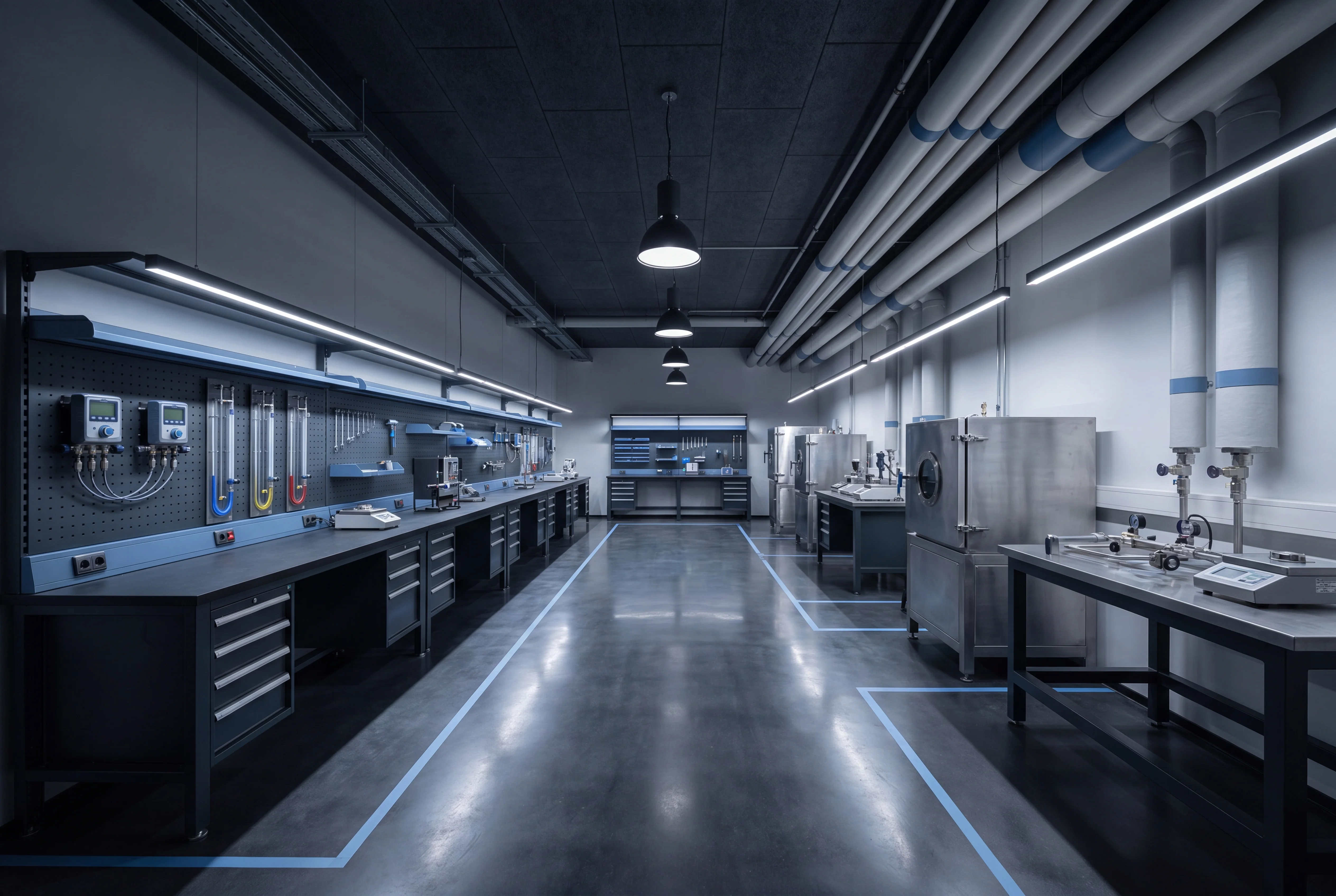
U-tube Manometer Calibration
Calibration of U-tube manometers requires rigorous evaluation of both the primary measurement scale and the fluid dynamics that dictate the indicated pressure. Because these instruments rely on the physical displacement of a liquid column - typically utilizing water, mercury, or proprietary gauge fluids - the calibration process must meticulously account for environmental variables that directly alter fluid density and hydrostatic equilibrium. Calibration is performed under ISO/IEC 17025 accreditation protocols to ensure documented measurement traceability to national metrology standards, such as those maintained by NIST. The verification procedure involves applying highly stable reference pressures using precision automated controllers or deadweight testers, subsequently comparing the standard against the manometer's observed differential height.
Critical parameters evaluated during this calibration sequence include:
- Verification of scale linearity, absolute zero-point alignment, and graduation accuracy across the entire operational range.
- Application of critical temperature corrections, as thermal expansion continuously alters the specific gravity of the indicating fluid.
- Mathematical compensation for local gravity variations, which fundamentally impact the primary hydrostatic pressure calculation.
- Inspection of the bore tubing for internal contamination or surface tension anomalies that could distort the meniscus and induce parallax reading errors.
- Pneumatic leak testing of the manifold and connection fittings to confirm absolute system integrity under sustained static pressure.
Digital Manometer Calibration
Digital manometer calibration is performed under strict ISO/IEC 17025 accredited procedures to ensure the integrity of electronic pressure measurements. Unlike liquid-column counterparts, digital manometers rely on piezoresistive or silicon capacitive sensors, which require precise voltage-to-pressure correlation. High-accuracy pneumatic or hydraulic comparators are utilized alongside NIST-traceable reference standards to evaluate the device across its full operating range. The calibration process involves multi-point verification to analyze key performance characteristics:
- Hysteresis and Linearity: Assessment of sensor response during both increasing and decreasing pressure cycles to identify deviations in the transducer element.
- Repeatability: Evaluation of the instrument's ability to provide consistent readings under identical pressure conditions.
- Zero and Span Adjustment: Corrections applied to align the digital output with reference standards at both zero pressure and full-scale limits.
- Temperature Effects: Verification of thermal compensation stability, as digital sensors are susceptible to drift caused by ambient temperature fluctuations.
All measurements are conducted in accordance with ASME B40.7 standards, providing documented test uncertainty ratios (TUR) to support industrial compliance and quality management systems.
Manometer Calibration in Dubuque
Industrial operations across Dubuque County, particularly within the Kerper Boulevard Industrial Park, the Dubuque Industrial Center West, and the McFadden property, generate a continuous demand for highly precise pressure instrumentation. Heavy manufacturing facilities such as John Deere Dubuque Works rely on intricate hydraulic systems and pneumatic test loops where differential pressure must be monitored with strict accuracy to ensure operator safety and machinery reliability. Similarly, established regional manufacturers like AY McDonald Mfg. Co. and Morrison Bros. Co., which specialize in brass valves, waterworks, and petroleum liquid-handling equipment, require highly precise pressure measurements during quality control and product verification phases. These municipal and commercial supply chains, operating near the tri-state junction of Iowa, Illinois, and Wisconsin, utilize both liquid column and digital manometers to regulate critical process loops, manage fluid transfers, and prevent hazardous system over-pressurization.
More on manometer calibration in Dubuque
Environmental management and specialized ventilation manufacturing, such as the processing systems operated at Klauer Manufacturing Company, further drive the regional requirement for localized calibration services. Industrial exhaust hoods, filtration units, and paint-spraying booths require constant monitoring of minute differential pressures to verify that airflow remains within safe occupational parameters. Inaccurate pressure readings in these ventilation systems can lead to compromised air quality, premature filter failure, or regulatory infractions. Consequently, local plants along the Northwest Arterial and near the Mississippi River waterfront maintain structured calibration schedules to guarantee that all pressure-sensing devices produce repeatable and verifiable data under variable environmental conditions.
Technical and Compliance Context for Pressure Instrumentation
The calibration of liquid column, inclined, and digital manometers requires strict compliance with recognized national and international metrology standards. Under the ISO/IEC 17025 standard, all calibration activities must demonstrate a documented, unbroken chain of comparison traceable directly to the National Institute of Standards and Technology (NIST). The overarching technical standard for these instruments, ASME B40.100, outlines the performance specifications, tolerance grades, and pressure containment requirements for gauges and indicating units. For facilities operating within highly regulated sectors, such as regional food processors or packaging plants adhering to FDA 21 CFR Part 211, routine pressure instrument verification is mandatory to prevent cross-contamination, manage sterilization chambers, and satisfy strict federal quality control audits.
Executing high-accuracy manometer calibration requires rigorous control over physical variables that alter hydrostatic pressure measurements. For traditional liquid-column instruments, metrologists must calculate precise corrections for local gravitational acceleration, ambient temperature, and the specific gravity of the indicating fluid. Digital manometers demand multi-point verification across their full scale to identify errors stemming from electronic hysteresis, thermal drift, and non-linearity in the silicon pressure sensors. Proper calibration methodology dictates a Test Uncertainty Ratio (TUR) of at least 4:1, ensuring the reference standard maintains sufficient accuracy to validate the operational tolerances of the instrument under test.
Related Services
Pressure Gauge Calibration
View in Dubuque ↗ RelatedDigital Pressure Gauge Calibration
View in Dubuque ↗ RelatedPressure Transmitter, Transducer & Sensor Calibration
View in Dubuque ↗ RelatedPressure Switch & Relief Valve Calibration
View in Dubuque ↗ RelatedLeak Tester Calibration
View in Dubuque ↗ RelatedPiston Gauge Calibration
View in Dubuque ↗Request manometer calibration in Dubuque.
Submit instrument details to receive an itemized quote within one business day. NIST-traceable results, documented for audit and compliance.